

Saudi Ceer launches first EVs with bigger plans for car market
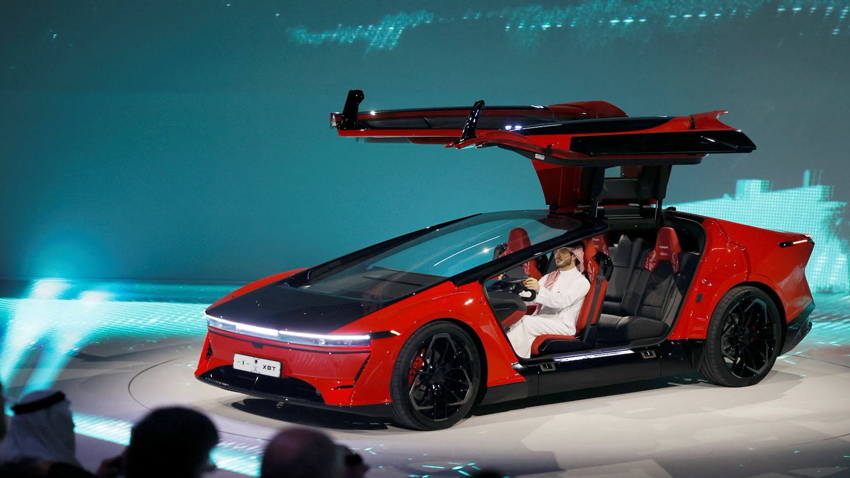
The Saudi startup introduced two fully electric models and plans to launch five more models by 2030. The first vehicles, called Exobot, are expected to go on sale in Saudi Arabia in early 2027.
Futuristic EVs target new market
The Exobot sedan and SUV feature designs inspired by science-fiction vehicles. Both models have upward-opening “gullwing” doors that give them a distinctive look.
Ceer has also removed the usual pillars between the front and rear seats. CEO Jim DeLuca said high-strength materials will provide the needed structural support.
"We wanted to make sure the world could see what Saudi Arabia is capable of," he said. The company is using the new vehicles to showcase Saudi Arabia’s ambitions in the electric vehicle market.
Global companies join Ceer project
Ceer is a joint venture between Saudi Arabia’s Public Investment Fund and Taiwanese electronics manufacturer Foxconn. The project benefits from Saudi investment and the country’s efforts to develop a domestic manufacturing network.
Foxconn has developed the electrical architecture for the Exobot vehicles. German automaker BMW has also provided engineering support for the project.
Several major suppliers have established factories in Saudi Arabia with government incentives. These include US-based Lear, South Korea’s Shin Young, Germany’s Benteler and China’s Fangxin.
Ceer expands beyond electric cars
Ceer initially planned to operate as a fully electric vehicle company. However, DeLuca said the company will also produce plug-in hybrids and combustion-engine vehicles as customer demand changes.
After the initial EV launch, Ceer plans to introduce five mainstream models between 2028 and 2030. The company says these vehicles will meet global regulations and could eventually be sold in different international markets.
Ceer plans to expand into nearby markets in 2028 before targeting wider markets across the Middle East and North Africa. The company intends to grow gradually through 2034.
"We want to make sure we move very methodically," DeLuca said. "It only takes one mistake and you can kill a startup." His comments highlight the risks facing new EV companies in an increasingly competitive market.
Saudi faces challenges in auto push
Saudi Arabia has previously tried to develop local vehicle production but struggled to attract large-scale manufacturing projects. A proposed Jaguar Land Rover factory in the country was abandoned more than a decade ago.
Toyota also rejected a proposed deal in 2019, citing high labour costs and a shortage of local suppliers. Ceer is taking a different approach by combining international partners with a growing network of local manufacturers.
The company is entering the market as Chinese automakers continue to expand their global presence. Several EV startups, including Fisker, Arrival and Lordstown, have also failed in recent years.
Vietnamese EV maker VinFast, where DeLuca previously served as CEO, is restructuring after spending billions of dollars on expansion. Ceer will therefore face both strong competition and the financial challenges that have affected other new EV companies.
Ceer’s first EV launch is part of Saudi Arabia’s wider effort to build industries beyond oil. The company is combining Saudi investment with technology and manufacturing support from international partners.
The planned expansion will depend on demand, production capacity and competition in the global EV market. Its decision to add hybrids and combustion-engine vehicles also shows that the company is preparing for changes in consumer demand.
Also read: Islamabad Police to get 50 electirc cars for patrolling
Also read: Customs seizes smuggled cars worth over Rs113,500,000 in Islamabad crackdown


