



Iran targets US assets in Bahrain and Jordan as Hormuz tensions deepen
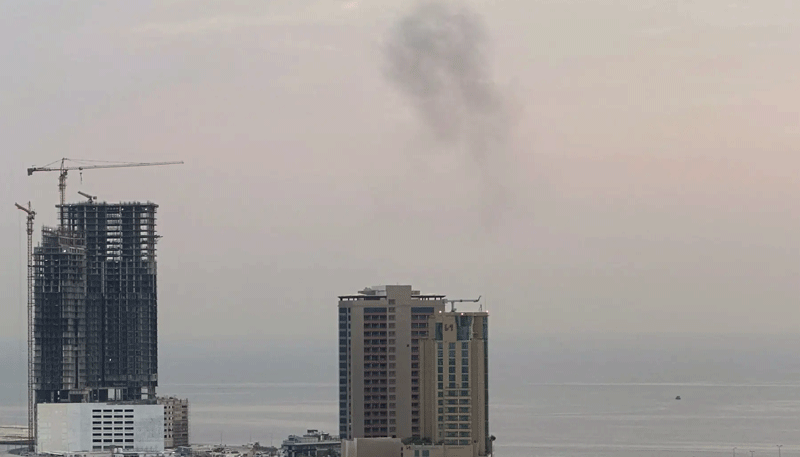
The latest escalation has increased fears of a wider conflict across the Middle East.
The United States carried out another round of military strikes on Iran for the third straight day. The attacks came after President Donald Trump announced a renewed blockade on Iranian ports and proposed a 20 percent fee on cargo passing through the Strait of Hormuz.
Despite the military action, Trump said a deal with Iran was still possible. However, tensions rose further after two ships were attacked in the Strait of Hormuz, leaving one crew member dead, according to the United Arab Emirates.
Iran’s Revolutionary Guards Corps, known as the IRGC, claimed responsibility for striking two “offending supertankers”. The group said the vessels ignored warnings, switched off navigation systems and attempted to travel through a “mined route”.
The IRGC did not identify the ships involved. It also did not confirm whether they were the same vessels mentioned by UAE authorities.
Iran accused the United States of encouraging ships to use what it called an illegal route. The IRGC warned that cooperation with the “aggressor enemy” could lead to more damage, shipping delays and even a global energy crisis.
The US military said its latest five-hour operation targeted several locations across Iran. These included coastal areas in Bushehr and Bandar Abbas that Washington said were linked to attacks on commercial shipping.
According to US Central Command, precision weapons were used against Iranian coastal defense systems, missile sites, drone facilities and maritime assets. The US also said more than 50,000 American service members remain deployed across the Middle East.
After the strikes, the IRGC announced missile and drone attacks on Bahrain. It claimed to have targeted a residential building for US forces, weapons storage sites and communication facilities at Bahrain’s Juffair base.
Also read: Iran mocks Trump over Strait of Hormuz security remarks
Iran also claimed that its attacks damaged radar systems linked to the US Navy’s Fifth Fleet. The IRGC further stated that fuel storage facilities and control centers for unmanned boats were destroyed.
Neither the United States nor Bahrain immediately responded to these claims. Independent verification of the reported damage was not available.
Meanwhile, Jordanian state media reported that four missiles entering the country’s airspace from Iran were intercepted and shot down. Later, the IRGC claimed it had targeted a military base in Jordan that hosts US forces.
Iran’s statement also appealed to the Jordanian public. It urged people to oppose American military bases in their country.
The statement said, “You know very well that not only do we not have any enmity with your country, but we also love you, the noble people, who understand the pain and oppression of the Palestinian people more than any other nation”.
Iran maintains that its military actions are directed only at US interests in the Gulf region. However, an Iranian military spokesman warned that any Gulf country helping the United States could be viewed as committing “an act of war”.
The growing crisis is closely linked to the Strait of Hormuz, one of the world’s most important shipping routes. Recent fighting has raised new doubts about efforts to secure a lasting peace in the region.
Trump announced that the United States was “taking over” security responsibilities in the strait. He also said a 20 percent charge would be imposed on cargo moving through the waterway.
On Truth Social, Trump declared that the United States would be known as “THE GUARDIAN OF THE HORMUZ STRAIT”. He added that while Iranian ports would face renewed restrictions, other countries would continue to have access to the route.
US Central Command said Iranian ports along the waterway would face a blockade beginning Tuesday evening. The move marked a significant escalation in pressure on Tehran.
Iranian Foreign Minister Abbas Araghchi responded with sarcasm on social media. He wrote that Trump was “absolutely right” that safe passage should come with compensation, but suggested Iran would charge a lower fee.
“Twenty per cent is of course too much,” he said. His remarks highlighted the continuing disagreement between Washington and Tehran over control and access to the strategic shipping lane.
The latest attacks show that tensions between the United States and Iran are rising quickly. Both sides appear willing to increase pressure while still talking about possible negotiations.
The Strait of Hormuz remains the key issue in the crisis. Any disruption there could affect global oil supplies, shipping costs and energy prices around the world.