

Nepal flood death toll reaches 1,204 as tunnel rescue continues
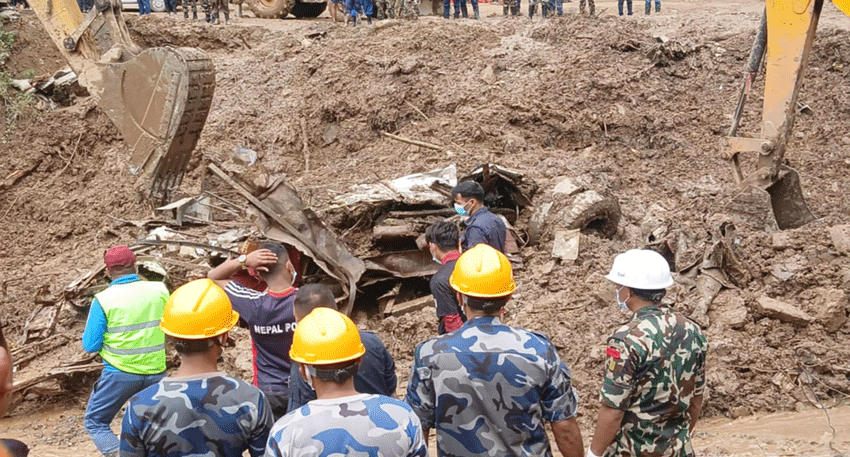
Rescuers are focusing on several tunnels in Nepal’s mountainous areas, where dozens of workers may have survived after being cut off by floodwaters and debris.
Authorities said some underground chambers have air, food and water, giving rescue teams a possible chance of finding survivors even after several days.
More than 4,200 people are still missing following the devastating flood, which was triggered by the collapse of a glacier near Nepal’s border with China.
Rescue teams focus on hydropower tunnels
The search has increasingly shifted towards hydroelectric projects because some workers may have reached protected areas inside the tunnels.
Officials believe around 900 missing workers could be connected to the affected hydropower projects. However, the exact number of people trapped inside individual tunnels remains under investigation.
Amshu Kiran Shahi, a board member of the Nepal Electricity Authority, said rescuers remained hopeful because some underground areas were believed to contain essential supplies.
“We are very confident that there is life in there because ... there is food and water in the building,” Shahi told Reuters.
One of the key locations is the Trishuli-3A hydropower project. Officials believe the site contains a dry chamber where people could have survived.
Rescue workers are also using pipes to send oxygen into parts of the tunnel as they attempt to reach people who may still be alive.
Hope remains despite growing challenges
Authorities have acknowledged that the possibility of finding survivors elsewhere is becoming weaker as time passes.
Phanindra Paudel, a senior official at Nepal’s National Emergency Operation Center, said the search would continue despite the difficult conditions.
“The hope of finding survivors is decreasing,” Paudel said. “We pray and are hopeful. Hope is hope.”
Prime Minister Balendra Shah has also said the government will continue rescue operations and search for people who remain unaccounted for.
“Our priority remains clear: To continue our search and rescue operations, find those who are still missing and continue supporting everyone affected,” he told parliament.
The rescue effort is being complicated by damaged roads, unstable mountain slopes, fast-flowing water and large amounts of debris across the affected areas.
International teams join tunnel rescue
Major rescue operations are taking place or being planned at four hydropower projects.
Two of the locations are considered to offer the strongest possibility of finding survivors because officials believe air remains available inside the tunnels.
Specialist teams from India, China and the United States are assisting with the search and rescue operations.
Their involvement has brought additional equipment and expertise to a difficult operation involving collapsed structures, blocked tunnels and unstable mountain terrain.
The disaster has affected both Nepal and nearby areas of Tibet, where authorities have also reported deaths and missing people.
China expands rescue efforts in Tibet
China has reported 21 deaths in Tibet, while 541 people remain missing, according to the latest figures cited in the report.
The situation improved after Beijing reopened the road leading to the Gyirong border crossing. The road had been badly damaged by the powerful flow of water and debris.
The reopening has allowed heavy rescue equipment to enter areas that were previously difficult to reach.
Chinese state broadcaster CCTV showed excavators, rescue personnel, search dogs and life-detection equipment working in a narrow mountain gorge.
Rescuers are searching damaged buildings, parking areas and dormitories as part of what local authorities described as a “deep search” for survivors.
China’s missing-person figures include 104 Nepali citizens, 49 Indians and 33 Latvians.
Many of the Indian nationals were reportedly travelling to Lake Mansarovar and Mount Kailash, important Hindu pilgrimage destinations in Tibet.
China has also said it will provide additional DNA identification experts and emergency supplies to support relief efforts in Nepal.
The supplies include temporary Bailey bridges, refrigeration equipment for bodies and communications equipment.
Also Read:Iran displays downed US MQ-9 drone after fresh strikes
Survivors face a difficult recovery
While rescue teams continue their work, survivors are returning to areas where homes, businesses and infrastructure have been destroyed.
Residents in affected communities have been searching through the remains of their homes to recover whatever belongings they can find.
Shanta Sunar, a 45-year-old shopkeeper from Nuwakot, said she and her husband managed to escape safely but lost almost everything.
“My husband and I were able to escape safely. But we could not pick up anything,” she said.
Sunar said the loss of their belongings was painful, but surviving the disaster remained the most important thing.
The disaster has also affected children living in Nuwakot and Rasuwa.
Save the Children said many children were showing signs of fear and anxiety after witnessing the destruction.
Some children reportedly saw school buses carrying friends being swept away, while others watched their homes disappear under floodwaters.
Damage to power and communications
The disaster has caused serious damage to infrastructure across the affected areas.
Prime Minister Shah said the government was working to restore electricity, telecommunications and transportation services.
Around 95% of telecommunications services in affected areas had reportedly been restored by Tuesday.
However, the floods disrupted about 431 megawatts of electricity-generating capacity, adding pressure to the country’s recovery efforts.
The government is also working to reconnect communities that remain isolated because roads and bridges were damaged.


