

ESPN founder Bill Rasmussen dies at 93, leaving lasting legacy
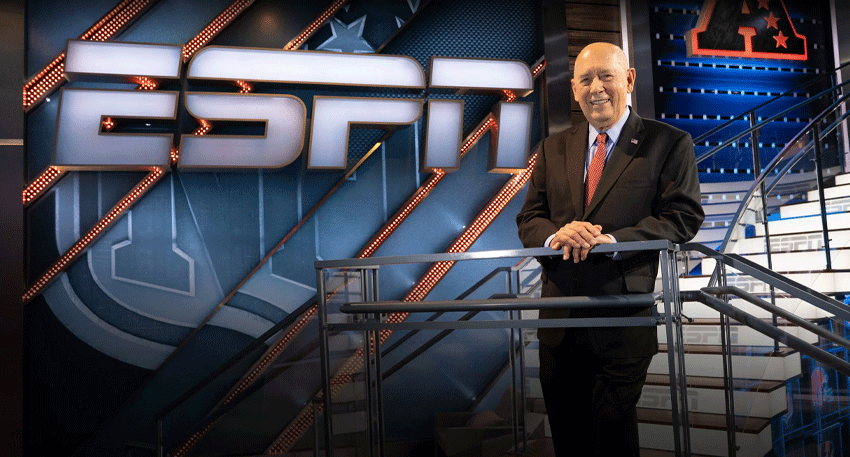
Rasmussen died on Tuesday after health complications linked to Parkinson’s disease. His death marks the passing of one of the key figures who helped change sports television in the United States.
“Bill was a remarkable man, a visionary and an innovator who conceived the idea of a network entirely devoted to sports,” ESPN Chairman Jimmy Pitaro said.
Rasmussen’s vision began more than four decades ago, when dedicated sports television was still a largely untested idea. Together with his son Scott, he started exploring the possibility of creating a sports-only network in 1978.
How Bill Rasmussen built ESPN
Rasmussen and his son looked at emerging satellite technology as a way to deliver sports programming to viewers across a much wider area.
Their idea eventually became ESPN, which officially launched on September 7, 1979. The network initially reached around 1.4 million homes, with SportsCenter serving as its first programme.
Rasmussen became ESPN’s first president and was named chairman in July 1979. He remained involved in the company during its early development before leaving an active role in October 1980.
Although his direct involvement lasted only a short period, the foundation he helped establish became one of the biggest transformations in sports media.
ESPN introduced a new model based on continuous sports coverage. It helped make sports news, analysis and live events available to viewers throughout the day.
ESPN grows from a small network
ESPN has expanded dramatically since its early days. The company began with about 80 employees but has grown to more than 5,900 employees around the world.
Its operations now include eight US television networks, a sports application and ESPN Audio, along with other sports media services.
The network also became known for expanding coverage beyond major professional leagues. Under Rasmussen’s early leadership, ESPN helped bring attention to events such as the opening rounds of the NCAA men’s basketball tournament.
That approach helped establish the idea that viewers could turn to one network whenever they wanted sports information or coverage.
Rasmussen’s original concept also helped shape the wider sports media industry. Dedicated sports programming later became a major part of television and digital entertainment.
Rasmussen’s contribution receives major recognition
Rasmussen’s influence was recognised several times during his later years. In 2025, he was inducted into the Sports Broadcasting Hall of Fame.
He was also included in the Sports 100 list, which recognises 100 of the most important figures in American sports history.
His family also remembered his life beyond his professional achievements. His wife, Lois, died in 2011, and he is survived by two sons, a daughter, seven grandchildren and two great-grandchildren.
The family has not been described as having released additional details beyond the announcement surrounding his death.
Also Read:Kamran Akmal raises fresh concerns over Pakistan bowling attack
A lasting impact on sports television
Rasmussen’s biggest contribution was the belief that sports could support an entire television network. At the time, that idea was far from certain.
ESPN’s growth eventually proved that there was strong demand for continuous sports coverage. The network became an important part of American sports culture and expanded its reach across television, digital platforms and audio.
His early vision also helped create new opportunities for sports journalists, broadcasters, analysts and production teams.
Today, sports fans can access live matches, breaking news, statistics and analysis across multiple platforms. Rasmussen’s original idea played an important role in helping build that environment.


