

Broad Peak tragedy: Five foreign climbers’ bodies arrive in Islamabad
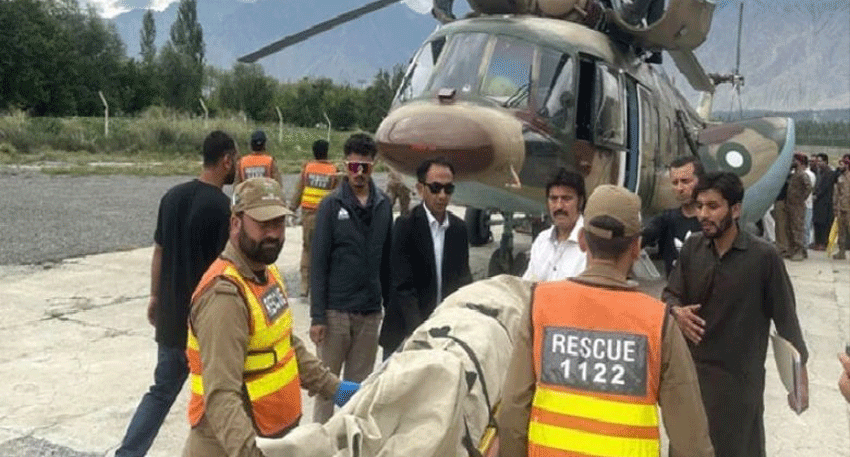
Broad Peak avalanche victims brought to Islamabad
The bodies of five foreign mountaineers who lost their lives in the Broad Peak avalanche arrived in Islamabad on Friday aboard AirBlue flight PA 703. After landing at Islamabad International Airport, the bodies were carefully unloaded and transferred to the Pakistan Institute of Medical Sciences (PIMS), where they were placed in the hospital’s mortuary.
The climbers had died after a powerful avalanche struck Broad Peak in Gilgit-Baltistan during an international mountaineering expedition. Their bodies were earlier recovered from the mountain and transported from Skardu to Islamabad after rescue teams completed the necessary arrangements.
Victims identified after recovery operation
Officials identified the deceased climbers as four Nepali nationals; Nima Sherpa, Nirmal Purja, Gelu (Gyallu) Sherpa and Kili Pemba Sherpa, along with Chinese climber Wang Zhong.
Deputy Chief Airport Security Officer of the Airport Security Force (ASF), Muhammad Rasheed, supervised the transfer process at Islamabad Airport. Authorities completed all arrangements before the aircraft landed to ensure the respectful handling of the remains.
Officials had earlier confirmed that the bodies of seven foreign climbers were expected to be transported from Skardu following the recovery operation. The latest arrival marks another stage in the ongoing efforts after the deadly mountain disaster.
Broad Peak avalanche triggered major rescue mission
The tragedy unfolded last week when an avalanche struck Broad Peak in Shigar district, Gilgit-Baltistan. A 10-member international climbing expedition was caught in the disaster while moving from Camp II to Camp III.
The expedition was led by renowned Nepali climber Nims Dai and included mountaineers from Pakistan, Nepal, China, Oman, the United States and several other countries. Pakistani climber Sohail Sakhi was also part of the international team.
The sudden avalanche created extremely dangerous conditions, making rescue operations difficult. The steep terrain, freezing temperatures and unstable snow slowed recovery efforts and increased the risks faced by rescue teams.
Rescue teams faced harsh mountain conditions
Pakistan launched a large-scale search and rescue mission immediately after the avalanche. Pakistan Army helicopters, experienced high-altitude porters, volunteer climbers and professional rescue personnel worked together to locate the missing mountaineers.
Emergency teams from Rescue 1122, local police and the health department remained on high alert throughout the operation. Despite difficult weather and challenging mountain conditions, rescue workers continued searching for survivors and recovering victims.
Officials praised the dedication of the rescue teams, who worked in one of the world’s most dangerous high-altitude environments. Their efforts highlighted the challenges of conducting rescue operations on some of Pakistan’s highest peaks.
Also Read:Lahore issues special traffic plan ahead of JI protests
Broad Peak remains one of the world’s toughest mountains
Broad Peak is one of Pakistan’s highest mountains and is known for attracting experienced climbers from around the world. However, unpredictable weather, avalanches and extreme altitude make it one of the most dangerous climbing destinations.
Every year, international expeditions attempt to reach its summit during the climbing season. Even with modern equipment and careful planning, sudden weather changes can quickly turn a routine climb into a life-threatening emergency.
The latest tragedy has once again highlighted the serious risks faced by mountaineers attempting to scale some of the world’s tallest peaks.