

Wife of Malaysia's longest-serving PM Mahathir dies at 100
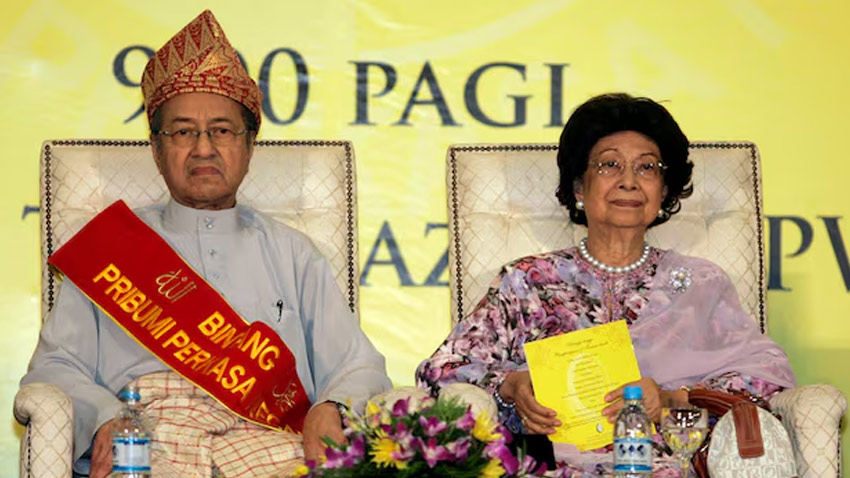
Siti Hasmah Mohamad Ali, the wife of Malaysia’s longest-serving prime minister, Mahathir Mohamad, died at the National Heart Institute in Kuala Lumpur at the age of 100.
Her death was confirmed by her son, Mokhzani Mahathir, while Mahathir’s office also confirmed the news. Bernama reported that Siti Hasmah is survived by her husband and seven children.
Her death marks the end of a long life that was closely linked with Malaysia’s political and social history. However, Siti Hasmah was known for much more than being the wife of a former prime minister. She built her own career as a doctor and became involved in public health and social causes.
A life closely linked with Malaysia’s political history
Mahathir, 101, served as Malaysia’s prime minister for more than two decades across two separate periods.
His first term lasted from 1981 to 2003. During those years, Malaysia went through rapid industrial and economic growth, with Mahathir playing a major role in the country’s development.
He returned as prime minister in 2018 after coming out of retirement and became the world’s oldest serving prime minister at the time.
His second term in office lasted less than two years and ended in 2020 after political divisions led to the collapse of his governing coalition. Siti Hasmah remained a familiar figure throughout both periods of Mahathir’s political career.
Siti Hasmah built her own public service legacy
Although widely recognised as Mahathir’s wife, Siti Hasmah established a public identity of her own through decades of medical and social work.
She was a pioneering doctor and became involved in public health programmes, particularly those focused on maternal and child health, immunisation, rural communities and women’s welfare.
Her work also included efforts related to drug abuse prevention, adult literacy and the development of rural women. Bernama reported that she played an important role in promoting healthcare and social development in Malaysia.
Her medical career began after she studied at the King Edward VII College of Medicine in Singapore. She later worked in several medical positions, including in Kedah, where she witnessed the healthcare challenges faced by rural communities.
Those experiences influenced much of her later work in public health.
Mahathir and Siti Hasmah shared decades
Mahathir and Siti Hasmah first met while studying medicine in Singapore in the late 1940s.
The couple married and went on to spend more than seven decades together. They raised seven children, including businessman Mokhzani Mahathir, social activist Marina Mahathir and politician Mukhriz Mahathir. Their long marriage remained an important part of Malaysia’s modern political history.
Siti Hasmah stood beside Mahathir throughout his long political career, including his rise to power, retirement from politics and return to the prime minister’s office in 2018. Mahathir had previously described his wife as an important source of support in his life and career.
Mahathir praised her determination
Mahathir also spoke publicly about Siti Hasmah’s determination to pursue higher education at a time when university education was uncommon among many Malay women. He admired her decision to obtain a university degree and regarded it as a sign of her strong character.
In a 2018 interview with CNN, Mahathir said:
"That, I think, reflects her strength of character," he told CNN in 2018.
The remark highlighted the respect Mahathir had for his wife’s determination and personal achievements.
Malaysia accords Siti Hasmah a state funeral
Following her death, the Malaysian government decided that Siti Hasmah would receive a state funeral.
Also Read: Beware! loud music on buses will cost you heavily under new rules
Prime Minister Anwar Ibrahim expressed his condolences to Mahathir and the family and directed senior government and defence officials to assist with the funeral arrangements. Siti Hasmah’s remains were taken to As-Syarif Mosque in Seri Kembangan for funeral preparations and prayers.
Bernama reported that funeral prayers were scheduled after Asar prayers, after which she would be laid to rest at Pusara Negara, Malaysia’s National Cemetery in Precinct 20, Putrajaya. Members of the public were also allowed to pay their last respects at the mosque.
Tributes pour in after her death
Siti Hasmah’s death prompted condolences from Malaysian political figures and members of the public.
Prime Minister Anwar described her passing as a great loss to society and the nation. Deputy Prime Minister Ahmad Zahid Hamidi also described her death as a profound loss and highlighted her service as a doctor and her concern for the welfare of the community.
Her contributions to women, families and public health were also highlighted following her death. She was remembered not only for her years alongside Mahathir but also for her own work in medicine and public service.
A legacy beyond the role of first lady
Siti Hasmah’s public life extended well beyond her role as the wife of a prime minister.
Her medical career and decades of work in public health gave her a separate place in Malaysia’s social history. She worked to improve healthcare access for rural communities and supported programmes focused on women and children.
She also represented Malaysia in several international forums and remained involved in social and humanitarian causes.
Her journey from a medical student in Singapore to a pioneering Malay woman doctor and later a prominent public figure reflected the changing role of women in Malaysia. Her death at the age of 100 closes a long chapter in the country’s public life.


