

Markets react to US strikes on Iran with higher oil prices and uneven Asian trading
Brent crude rose 2.6% to $76.09 a barrel, while US crude (WTI) gained 2.6% to $72.25 a barrel. Oil prices had recently fallen back to levels seen before the Iran conflict escalated in late February.
Stock markets across Asia showed mixed results. Japan's Nikkei 225 fell 0.3%, South Korea's Kospi dropped 2.9%, and Taiwan's Taiex slipped 0.2%. Meanwhile, Hong Kong's Hang Seng rose 2.4%, and China's Shanghai Composite gained 0.5%.
In South Korea, major technology shares remained under pressure. Samsung Electronics lost 2.9%, while SK Hynix rose 2.4%.
Also Read: US tightens Iran oil waiver, Tehran vows strong response
Chinese technology companies helped lift markets in Hong Kong and mainland China. Tencent gained 3.1%, Alibaba jumped 8.1%, and Baidu climbed 4.7% as investors remained optimistic about China's AI industry.
Elsewhere, Australia's S&P/ASX 200 and India's Sensex both fell 0.7%. On Wall Street, technology stocks dragged the market lower.
The S&P 500 fell 0.4%, the Nasdaq Composite dropped 1.2%, and the Dow Jones Industrial Average slipped 0.2% as investors worried that AI company shares may be too expensive.
Among chipmakers, AMD fell 6.5%, Intel dropped 9.7%, and Micron Technology lost 4.7%. SpaceX, which now includes the xAI business, fell 6.8% on its first day in the Nasdaq-100 Index.
Rivian Automotive also dropped 18.1% after announcing plans to sell 75 million new shares.
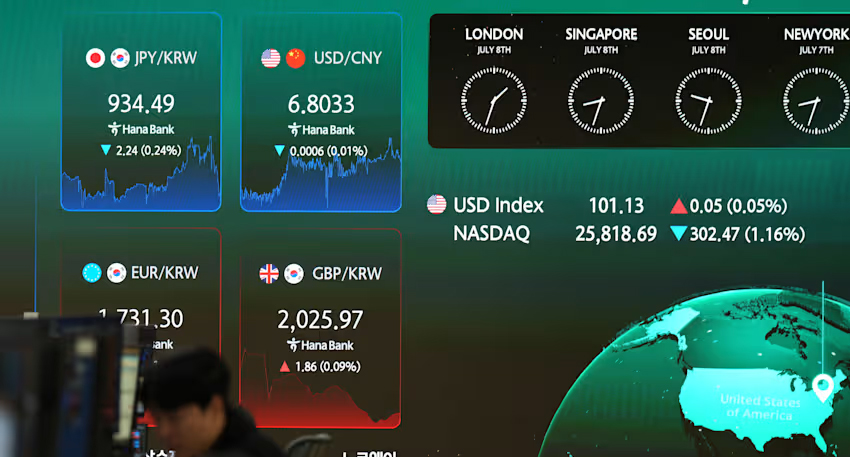
In currency trading, the US dollar strengthened slightly against the Japanese yen, while the euro remained almost unchanged.