

Trump warns Iran of harsh response after new missile strikes
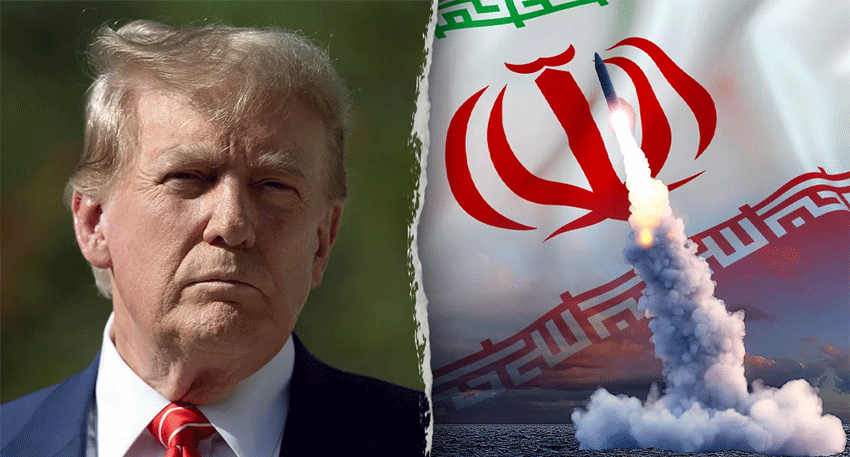
Trump threatens a strong response
US President Donald Trump has warned Iran of further military action after the two countries exchanged attacks for the first time in about a month.
Iran fired missiles overnight at two US military bases in Jordan after American forces attacked Iranian launchers on Larak Island.
Washington said the launchers were preparing to fire rockets carrying sea mines into the Strait of Hormuz. The exchange has raised fresh concerns that the conflict could move back toward direct military confrontation.
“We’re going to hit them hard,” a Fox News reporter quoted Trump as saying. “There will be a response.”
Trump later told reporters at the White House that the latest attacks did not necessarily mean a return to full-scale war.
He described Iran as a “failed nation” and said its military and economy had already suffered heavy damage.
“That doesn’t mean we won’t smack them. We’ll see what happens,” Trump said.
Asked about the possible use of nuclear weapons, Trump said there was “no reason” to consider such action because he believed Iran had been “totally defeated militarily.”
Iran warns of a harsher response
A senior Iranian source described the latest exchange as a “limited and contained confrontation”.
However, the source warned that Tehran would respond strongly if the United States carried out another attack.
The exchange marks the first direct military confrontation between the two sides since late July.
For several weeks, Washington had relied more heavily on sanctions, economic restrictions and pressure on Iran rather than major new attacks.
The latest strikes show that military escalation remains possible despite those efforts.
Trump said US air defences had intercepted all Iranian missiles that could have caused damage. He also claimed that American economic measures were having a major effect on Iran.
The US administration has increasingly linked its economic campaign with its broader strategy to pressure Tehran.
AI videos add to tensions
Trump also shared two videos on social media that appeared to show explosions destroying Iran’s main oil export terminal on Kharg Island.
However, the videos were generated using artificial intelligence and did not show an actual US attack on the Iranian oil facility.
Iran described the post as “laughable”.
Vice President JD Vance said Trump sometimes uses social media to send messages and suggested the posts were intended to put pressure on Tehran.
The incident has added another unusual element to an already tense confrontation between the two countries.
So far, Washington has largely avoided directly attacking Iran’s major oil and gas infrastructure.
Iran has warned that attacks on such facilities could lead to severe retaliation against US allies and Gulf countries.
Washington increases economic pressure
Instead of focusing only on military operations, the US has also increased financial pressure on Iran.
US Treasury Secretary Scott Bessent said Iran was facing serious economic difficulties because of the American campaign.
“They’re in shock at the state of their economy,” Bessent told reporters at a G20 meeting.
Bessent suggested that Iran’s recent military response could partly be linked to the growing economic pressure.
“I would think that they are lashing out kinetically because they are losing economically,” he said.
The US has introduced secondary sanctions targeting countries and companies that continue to do business with Iran.
Bessent previously said Washington could announce new secondary sanctions every week as part of its effort to restrict Tehran’s access to international finance.
Banks are expected to remain an important focus of the campaign.
US strikes Larak Island
The latest military escalation began when US forces attacked two Iranian launchers on Larak Island.
According to a US official, Iranian Revolutionary Guard forces had been preparing to launch rockets carrying sea mines into the Strait of Hormuz.
The US Central Command said it carried out “limited, precise” action against Iranian minelaying forces that represented an “imminent threat” to the waterway.
Iranian news agency Tasnim reported that three people were killed in the American strike. Iranian state-linked reports said two of those killed were members of the Revolutionary Guards Navy.
Larak Island is located near Bandar Abbas and sits close to the strategically important Strait of Hormuz.
The waterway normally carries around a fifth of global crude oil and gas shipments, making any disruption there a major international concern.
Iranian state television later reported that a supertanker had been struck by two naval mines and caught fire in the southern part of the strait.
The US military denied that claim.
Strait of Hormuz remains a major concern
The Strait of Hormuz has become one of the most sensitive points in the conflict.
Iran has maintained that the waterway is closed and will only reopen under conditions controlled by Tehran.
The situation has raised concerns among shipping companies and energy markets because any prolonged disruption could affect international oil and gas supplies.
The latest military exchange has increased those concerns.
The United States has said its actions are aimed at preventing Iran from placing mines in the waterway, while Tehran has warned against further American attacks.
The competing claims show how quickly events around the strait could lead to another confrontation.
Also Read:Saudi oil tanker ‘Cedar’ reportedly stopped in Strait of Hormuz
Iran still signals interest in talks
Despite the latest exchange of attacks, Iranian President Masoud Pezeshkian said Tehran still supported finding a negotiated way to end the conflict.
Speaking during a regional meeting in Kyrgyzstan, Pezeshkian discussed the issue with Indian Prime Minister Narendra Modi.
“We believe that continuing the war is in no one’s interest, neither ours, nor the region’s, nor humanity’s,” Iran’s Tasnim news agency quoted him as saying.
The statement suggests that Tehran still sees diplomacy as a possible way out, even as it prepares to respond to further military action.
The conflict previously moved toward a ceasefire before breaking down and returning to repeated military exchanges.
Trump’s objectives remain unresolved
Trump launched his campaign against Iran with several major objectives.
These included dismantling Iran’s nuclear programme, reducing its ability to attack regional opponents and creating conditions for political change inside Iran.
The latest developments show that those goals remain unresolved.
Washington continues to use military threats, sanctions and economic pressure against Tehran, while Iran continues to resist American demands.
The new exchange of fire has therefore created another difficult test for efforts to prevent a wider regional conflict.


