

Colombia’s strongest quake this century kills more than 100
Powerful earthquake strikes western Colombia
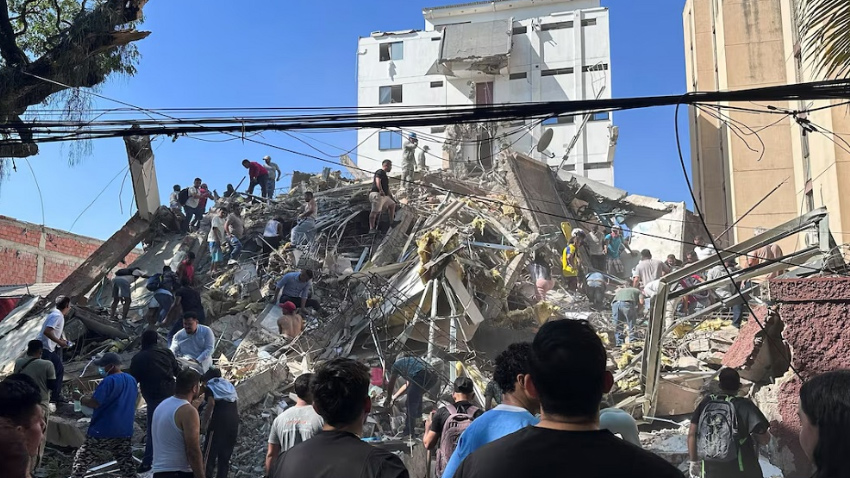
The earthquake has damaged residential buildings, hospitals, roads, and other infrastructure, leaving rescue teams searching collapsed structures for survivors. The US Geological Survey said the earthquake struck at a depth of 107 kilometres.
Colombia’s Geological Service described it as the strongest earthquake recorded in the country during the 21st century. The full extent of the damage is still being assessed as rescue operations continue in several affected areas.
Rescue teams race to find survivors
Emergency workers and volunteers have been searching through the rubble for people who may still be trapped.
Rescue operations continued into the night, with workers using headlamps, cranes, and other equipment to reach damaged buildings. In Cali, firefighters reported rescuing two women and two children from a collapsed building.
In another rescue operation, a six-month-old baby and her mother were reportedly pulled alive from beneath the rubble of a five-storey building. The successful rescues have raised hopes that more survivors could still be found.
Cali among the worst-hit cities
Cali, one of Colombia’s largest cities, has suffered significant damage from the earthquake. Authorities in Valle del Cauca province reported 35 deaths and around 700 injuries in the region.
Several buildings were damaged, while emergency workers continued searching areas where people were believed to be trapped.
Residents described scenes of panic as buildings shook and parts of structures collapsed. Some residents said they feared their homes could have collapsed if the shaking had continued for longer.
Buildings collapse in Pereira and other areas
Pereira was also badly affected by the earthquake.
Rescue workers were seen clearing debris from damaged buildings while searching for people trapped underneath. Emergency teams used cranes and other heavy equipment to remove dangerous sections of damaged structures.
Video footage showed police officers, firefighters, and volunteers working together to clear rubble by hand. Other affected cities included Quibdo, Armenia, and Manizales, where authorities also reported damage and introduced emergency measures.
Curfews imposed amid security concerns
Authorities in Cali, Armenia, and Manizales announced curfews following the earthquake.
Officials said the measures were introduced partly because of concerns about looting in affected areas. Police and military personnel were deployed in Cali to protect residents and damaged properties.
President Abelardo De La Espriella also promised additional security personnel for the city. The government has declared a national state of emergency to speed up rescue and relief operations.
Airports suspended for safety checks
Colombia’s civil aviation authority suspended operations at several airports in the affected region.
Also Read: Why Trump‘s secret flight to Turkiye hid him from Iran danger
The airports included those serving Pereira, Manizales, Quibdo, Armenia, Cartago, and Buenaventura. Engineers were carrying out structural inspections to determine whether the facilities could safely resume operations.
The airport closures could affect travel and the movement of emergency supplies to areas hit by the earthquake. Authorities are expected to restore operations once safety inspections are completed.
Government launches emergency response
President De La Espriella visited Quibdo and Cali as the government began its response to the disaster.
He said the government’s priority was to save lives, assist affected communities, and provide emergency support. The president also promised rent assistance for people who had lost their homes.
The earthquake came only days after De La Espriella took office, making the disaster one of the first major crises faced by his administration. Officials are now coordinating rescue, medical, and relief operations across the affected regions.
Aftershocks create further concerns
The Colombian Geological Service reported multiple aftershocks following the main earthquake. Authorities have warned that additional tremors could occur as rescue and recovery operations continue. Aftershocks can further weaken buildings that have already been damaged by the main quake.
Residents have therefore been urged to stay away from severely damaged structures and follow instructions from emergency officials. The risk has made rescue work more difficult in some areas.
Colombia lies in the Ring of Fire
Colombia is located along the seismically active Pacific Ring of Fire, where several tectonic plates meet.
Also Read: US imposes fresh sanctions on Iran over Hormuz attacks
The country experiences thousands of earthquakes every year, although most are too weak to cause major damage. Scientists said the depth and strength of the latest earthquake contributed to the widespread shaking.
The earthquake’s location and movement also affected populated areas, increasing the risk of serious damage. The latest disaster has renewed concerns about earthquake preparedness and the safety of buildings in vulnerable areas.
Memories of the 1999 earthquake
The disaster has also brought back memories of Colombia’s devastating 1999 earthquake. A magnitude 6.2 earthquake struck the country’s coffee region that year, killing more than 1,000 people.
Armenia and Pereira were among the areas most severely affected. The latest earthquake has once again placed Colombia’s emergency response and building safety measures under close attention.
Festival postponed after deadly quake
The annual Petronio Alvarez festival in Cali has also been postponed following the disaster. The event, which celebrates Pacific music and culture, was scheduled to begin later this week.
Authorities decided to delay the festival as rescue and relief efforts remain the priority. The decision reflects the scale of the emergency facing the city and the surrounding areas.