

How humanoids break human records at Beijing Robot Games
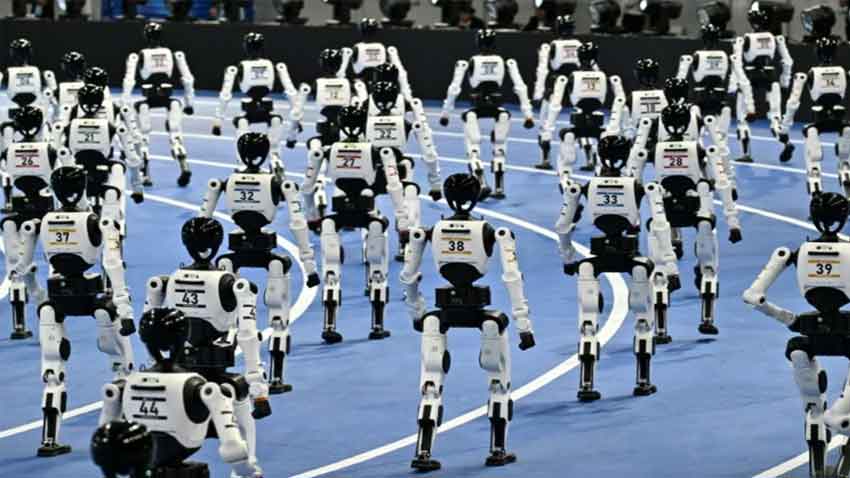
Humanoids rewrite records in Beijing
Dozens of humanoid robots and their human operators gathered at Beijing’s Olympic speed skating arena for the World Robot Games. The machines competed in athletics, boxing, football and martial arts, giving spectators both impressive performances and plenty of entertaining moments.
A major highlight came during Saturday’s opening ceremony when the white, headless humanoid Tiangong Ultra reportedly ran the 100-metre race in 9.39 seconds. According to Chinese state broadcaster CCTV, the time was faster than Usain Bolt’s 9.58-second mark set in 2009.
Robot sets another impressive record
The Tiangong Ultra model delivered another major performance on Sunday by setting a new 400-metre mark in the robot competition. It initially finished in 38.16 seconds, with the time later revised to 38.15 seconds.
The humanoid was developed by a Beijing research centre backed by the local government. During one race, a white-shelled robot moved around the track while swinging its arms and leaning dangerously forward, leaving spectators wondering if it would fall.
Some robots struggle in front of crowds
Not every machine performed smoothly at the Beijing Robot Games, as several robotic runners failed to start their races. Others moved around the track at little more than walking speed, while some collapsed immediately after the starting signal.
These failures became part of the entertainment for the crowd, with children and parents laughing and cheering as the robots struggled. A toddler-sized humanoid also kicked a football over knee-high barriers, producing loud cheers from the stands.
Human-level tasks remain the bigger test
The competition also raised questions about whether humanoid robots can eventually perform useful tasks beyond sports. In the boxing event, one humanoid stumbled toward the side of the ring and folded over the ropes before humans eventually carried it away.
Seventy-two-year-old spectator Hou Yali said she would like to see robots compete directly against humans. “We’ll be able to see more clearly whether machines can surpass humans,” said Hou, who is retired and lives in Beijing.
“Right now, this is just running, just a competition of speed. It’s not a test of intelligence, or hiring someone to do household tasks or act as live-in help,” she said.
Hou said she currently pays aides to clean her home and prepare meals each week. She added that she would like robots to eventually perform similar household duties.
“With the development of our country’s economy, people have more money in their pockets, and they may decide to use robots,” she said.
The Beijing Robot Games showed both the progress and weaknesses of humanoid robots. Breaking speed records is impressive, but making robots reliable enough for everyday household work remains a much bigger challenge.
The event also showed why human-versus-robot competitions could attract even more attention in the future. As technology improves, people may become more interested in whether robots can truly match humans in practical tasks, rather than simply running faster on a track.
Also read: Surveillance cameras: How to find out who is watching you
Also read: Girl kills younger sister over TikTok followers dispute in Gujranwala


