

Assessing Pakistan’s Position in the Evolving AI Landscape
I attened a workshop under the project titled “Digital Trust and Free Expression in the AI Era” at the Department of Media and Development Communication, University of the Punjab, supported by the U.S. Mission to Pakistan in partnership with the Pakistan-U.S. Alumni Network (PUAN) that was about the ethical usage of AI in the field of digital journalism and media. Though dimension is very significant for enhacing the capacity of media and information literacy but I am more interested in the recent development in the technology sector including the compute capacity centers’ building, World Artificial Intelligence Cooperation Organization (WAICO) membership and other projects by Pakistan govt that have surged a debate on the standing of Pakistan in a world of emerging AI and the scarce resources of the country. According to the Government AI Readiness Index 2025 of Oxford Insights, Pakistan ranks 81 out of 195 assessed governments worldwide, with a decent score compared to the regional average on almost all the pillars.
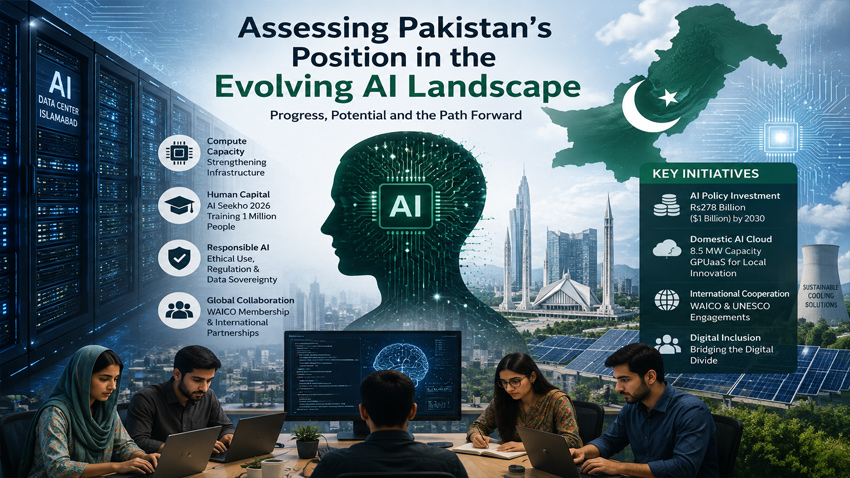
Revisiting the scores is relevant when compared to recent initiatives by the state for analyzing how Pakistan’s government is adopting and governing AI. The metrics demonstrate sustained engagement not only regarding policy vision but also in policy commitment and regulatory compliance, hovering around 60%. This is reflected in the government’s last year AI policy which envisages a Rs278 billion ($1 billion) investment by the end of this decade. It further includes nationwide “AI Seekho 2026” training program for one million people, expanded AI infrastructure, and a regulatory framework promoting the ethical use of AI.
However, to evaluate the categories with critical gap recent developments envisage significant improvement. For instance, regarding the Compute Capacity the score of 2025 report is below 10%, however, last month witnessed an inauguration of a Tier III data center and largest domestic AI cloud (8.5 megawatt) in Islamabad. The facility serves as a foundational digital hub by providing local startups, banks, and government agencies with high-performance GPU-as-a-Service (GPUaaS) to train and deploy artificial intelligence models domestically. In addition, by keeping critical telecom, financial, and healthcare records inside the country’s borders, this infrastructure ensures strict regulatory compliance and national data sovereignty while significantly reducing the nation's reliance on expensive foreign hyperscale cloud providers.
However, it does have its gaps. One of the major critiques on building these large AI data centers is regarding their cooling mechanism, which uses millions of liters of water. According to World Economic Forum, 1 megawatt (MW) data center can use up to 25.5 million liters of water annually for cooling. To put it into perspective the amount is equivalent to the daily water consumption of approximately 300,000 people. The critics in this light view the facility, similar projects also under development in Lahore and Karachi, as a burden to an already water scarce country. Nevertheless, is operationalized keeping in view the challenge it is entirely manageable with advanced alternative cooling techniques that reuses the similar water like in immersion cooling or direct-to-chip liquid cooling.
Similarly, as for Societal Transition, the initial work shows promise, but its long-term efficacy remains to be seen. The membership to WAICO, a China-initiated multilateral alliance established in July 2026, can be utilized for the collaboration at academic and civil sectors in research and execution. The government can embed WAICO's multilateral training platforms directly into domestic workforce initiatives, such as its public sector tech upskilling and research programs, ensuring that local computational growth adheres to equitable, peer-validated global standards. We also saw the forums like UNESCO Pakistan Governance 2026 bringing together federal and provincial leadership, parliamentarians, senior civil servants, development partners, academia, private sector actors, and civil society to deliberate on governance reforms and digital transformation priorities, but the digital divide requires more targeted initiatives.
Therefore, the standing of Pakistan in the era of AI is not completely discouraging. The initiative holds clear potential, yet achieving its impact demands strategic planning, optimized resource allocation, expanding technological access, the integration of AI and advanced technology, and sustained long-term investment. Ambitious steps are taken however, it requires more than mere enthusiasm to navigate the multifaceted landscape of local challenges.
The views, thoughts, and opinions expressed in this blog are solely those of the author and do not necessarily reflect the official policy or position of the U.S. Mission to Pakistan or USEFP/PUAN.


