

Hafiz Naeem demands Rs225 petrol price as protest enters sixth day
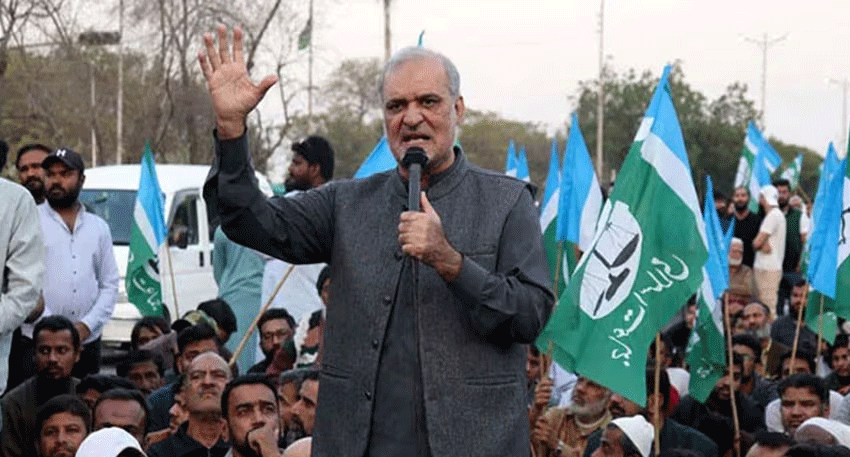
Jamaat-e-Islami chief Hafiz Naeem ur Rehman has stepped up pressure on the government over fuel prices and taxes as the party’s Karachi protest entered its sixth day.
Speaking to supporters at the sit-in, Hafiz Naeem said the government must withdraw the petroleum levy or face a nationwide protest movement.
He warned that JI could organise a march towards Islamabad from different parts of the country if the government failed to accept the party’s demands.
JI demands Rs225 petrol price
Hafiz Naeem said the government’s recent reduction in diesel prices was not enough to provide meaningful relief to consumers.
He demanded the complete removal of the petroleum levy and other taxes on fuel, along with a fixed petrol price of Rs225 per litre for three years.
“Our clear and unequivocal demand is that the petroleum levy is abolished and the price of petrol be fixed at Rs225 per litre for three years,” he said.
The JI chief said high fuel prices were affecting households, businesses and transport costs across the country.
He also urged people from different political and religious backgrounds to join the campaign, arguing that fuel prices were an issue affecting the wider population.
According to Hafiz Naeem, ordinary consumers are paying around Rs130 per litre through petroleum levies and other fuel-related taxes.
Nationwide march threat over petroleum levy
Hafiz Naeem warned that the party could bring supporters towards Islamabad if its demands were ignored.
“I want to make it clear to the rulers that if the petroleum levy is not withdrawn and our protest is ignored, we will march towards Islamabad from across the country,” he said.
He described the proposed mobilisation as a nationwide movement rather than a protest limited to Karachi.
“From Karachi to Khyber and Kashmir to Gwadar, people will march on foot towards Islamabad,” he said, adding that authorities could face a large public mobilisation.
The JI leader said the government might attempt to restrict movement towards the capital, but he claimed such measures would not stop the planned protest.
The warning comes as the party continues its sit-in in Karachi, where supporters, including women and children, have been attending the demonstration.
JI also targets electricity costs and IPP agreements
The JI chief linked the petrol price issue with wider concerns about electricity costs and government agreements with independent power producers.
He called for the cancellation of what he described as “anti-people” agreements with IPPs and demanded an end to what he termed excessive capacity payments.
Hafiz Naeem also called for cheaper electricity for consumers, saying high energy costs were adding to the financial pressure faced by ordinary families.
He referred to the party’s earlier campaign against IPP agreements and claimed that the protest had helped reduce electricity costs for some consumers.
According to his claim, residential consumers benefited by Rs8.64 per unit, while commercial consumers received an alleged reduction of Rs16.34 per unit.
He further claimed that agreements with five IPPs had been terminated, while negotiations with 22 other companies had been reopened.
Hafiz Naeem said these steps had allegedly provided a benefit of Rs3.4 trillion to the national exchequer.
Also Read: Punjab records major surge in driving licence issuance
Claims about government fuel and electricity spending
The JI leader also criticised government spending on fuel and electricity benefits for officials.
He claimed that “Rs380 billion worth of free petrol and Rs280 billion worth of free electricity had been provided to the government and bureaucracy during the previous year”.
He also said the government collected Rs1.566 trillion through the petroleum levy during the previous year.
According to Hafiz Naeem, the collection exceeded the government’s target by around Rs100 billion.
The figures were presented as part of his argument that the government could provide greater relief to consumers by reducing taxes and reviewing energy-related costs.
The JI leader said inflation had already made daily life difficult for ordinary citizens.


