

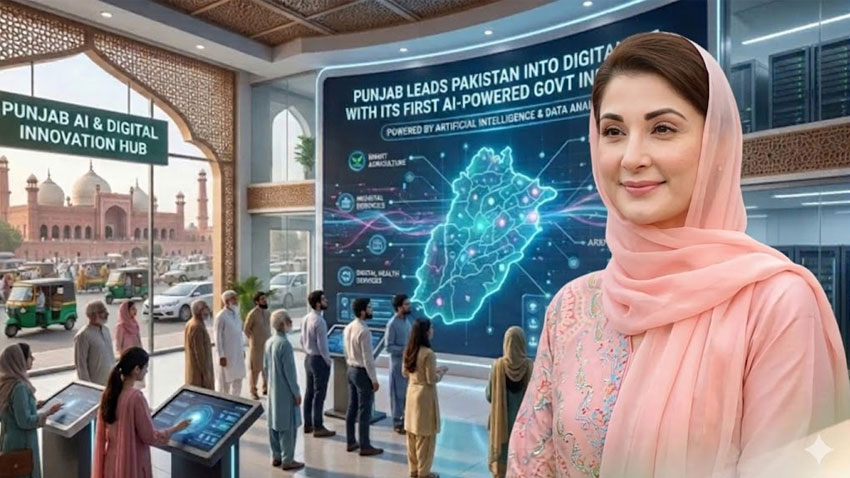
Punjab Chief Minister Maryam Nawaz has taken this major step by deciding to run government affairs with artificial intelligence. She launched Pakistan’s first AI-based governance model to modernize how public services are delivered.
Under this plan, the Chief Minister’s Office will be transformed into the “AI Office of the CM.” This will make it the country’s first fully AI-powered government office, aiming to bring faster and more efficient decision-making.
In a high-level meeting led by Senior Provincial Minister Marriyum Aurangzeb, important decisions were made to set up a special AI Delivery Unit. During the meeting, CM’s AI Advisor Ali Dar gave a detailed briefing on how the system will work.
Read more: 5G not working on iPhones, Pixels, Samsung phones in Pakistan? Here’s solution
CM Maryam Nawaz approved this advanced AI governance framework. The goal is to improve public services by using data and smart systems instead of traditional slow processes.
Officials also reviewed progress on projects like “AI Vision 2029” and the “Office of AI Punjab.” These initiatives are expected to bring transparency, accountability, and speed into government work.
The plan also includes setting up an AI Academy to train young people. They will learn modern skills like data analysis, smart monitoring, and AI-based systems, which can also create new job opportunities.
All government departments will be connected to a central AI unit. This will create a complete AI ecosystem where decisions can be made quickly and efficiently. Technology like virtual police stations is already helping improve safety for women and children.
The Punjab government is also working on a full AI policy with support from international partners, including the Foreign Commonwealth and Development Office. This will help implement AI across different sectors.
Read more: Jazz, Zong launch 5G in Pakistan - How to get ultra fast internet services
AI will now be used in health, education, agriculture, policing, and city management. Smart dashboards and centralized systems will make governance more organized and effective.
Experts believe this model can become an example for other regions. They say Punjab is moving toward a future where technology will play a key role in improving people’s lives.
This move can change how government offices work in Pakistan. If implemented well, services may become faster and more transparent. However, success will depend on proper training and strong systems. People may see real benefits if technology is used honestly and efficiently.


