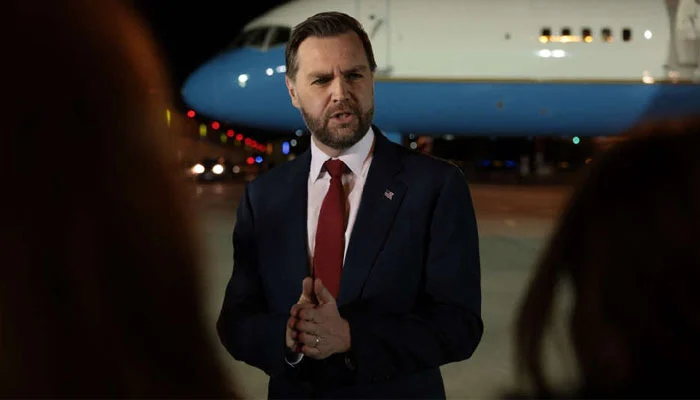
The United States has confirmed a major shift in US Iran talks, with Vice President JD Vance stating that the first 10-point proposal submitted by Iran has been rejected, and a second round of discussions is now underway.
According to Vance, the earlier proposal was “discarded,” and negotiations are now focusing on a revised framework involving Iran and Pakistan as part of broader diplomatic engagement.
Second Proposal Under Discussion Amid Renewed Negotiations
Speaking to the media, JD Vance claimed that misleading versions of the 10-point framework were being circulated by certain outlets, including reports referenced by international media and individuals in Iran.
He confirmed that discussions are now centered on a second 10-point proposal, with key focus areas including ceasefire conditions, regional stability, and maritime security.
Strait of Hormuz and Ceasefire at the Center of Talks
A major point of discussion remains the Strait of Hormuz, a critical global oil shipping route. Vance noted that maritime traffic through the waterway has increased and emphasized that any agreement must ensure:
- A stable ceasefire
- Continued negotiations
- Full reopening and security of the Strait of Hormuz
He stressed that stabilizing the region is directly linked to maintaining global energy flow.
Also Read: Three ceasefire terms violated before negotiations, says Iran
Sanctions Relief and Nuclear Restrictions
The US Vice President stated that Iran’s next steps will determine the direction of the negotiations. He suggested that Washington is open to discussing sanctions relief, depending on Iran’s commitments.
However, he clearly reiterated that Iran must not proceed with uranium enrichment, framing it as a key condition in any potential agreement.
Ceasefire Challenges and Misunderstandings
Addressing concerns about ceasefire violations, JD Vance acknowledged that ceasefires are often fragile and rarely free from complications.
He also commented on remarks made by Iranian Parliament Speaker Mohammad Bagher Ghalibaf, stating that he had reviewed the comments and viewed the disagreement as limited to a few points within a broader 15-point framework, suggesting significant areas of potential agreement.
Miscommunication Over Lebanon Ceasefire
Vance further claimed that misunderstandings had emerged regarding Lebanon, stating that Iran may have assumed Lebanon was included in the ceasefire agreement, while the United States never intended that inclusion.
He warned that if Iran chooses to allow disagreements over Lebanon to derail negotiations, it would be a political decision on their part.
Rising Diplomatic Pressure Ahead of Next Phase
The ongoing exchange highlights growing diplomatic pressure between Washington and Tehran, with both sides attempting to redefine the framework for negotiations.
Key issues such as uranium enrichment, sanctions relief, maritime security, and regional conflicts remain central obstacles to a breakthrough.