

Trump says US, Iran officials hold talks after ‘annihilate’ warning
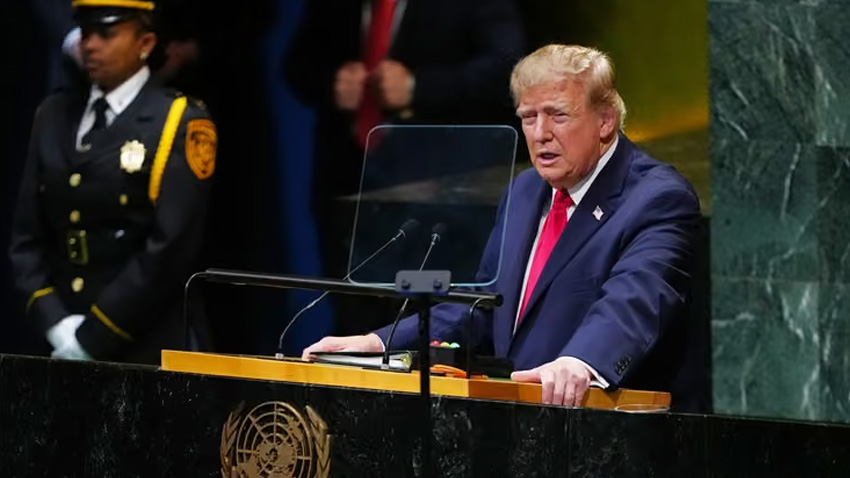
US President Donald Trump said American and Iranian officials met in New York on Tuesday for discussions linked to the conflict between the two countries.
Trump said his envoys, Steve Witkoff and Jared Kushner, were involved in the talks.
The meeting lasted about three hours and took place on the sidelines of the annual gathering of world leaders at the United Nations.
Trump described the discussions as “a very good meeting”.
However, he also said the Iranian representatives were “not the highest level, but it’s something”.
The talks were conducted indirectly, with mediators moving between the American and Iranian teams rather than the two sides holding direct, face-to-face negotiations.
Talks follow Trump’s warning at UN
The meeting came only hours after Trump delivered a strong warning to Iran during his address to the UN General Assembly. Trump said he faced a major decision over whether to reach an agreement with Iran or continue military action.
“I have a big decision to make,” Trump said.
He then presented two possible paths, including a deal that would allow Iran to rebuild or a decision to “annihilate the Islamic Republic”.
Trump said the United States wanted to prevent Iran from again posing what his administration considers a major security threat. His remarks came as diplomatic efforts continued on the sidelines of the UN gathering.
Witkoff says talks could prove constructive
Witkoff confirmed that the discussions took place through mediators.
In a post on X, he said the mediators moved between the American and Iranian teams during the talks. He expressed hope that the diplomatic effort would prove “constructive and promising”.
The comments suggested that communication between Washington and Tehran had resumed despite months of tensions and military confrontation. The talks are being closely watched because previous efforts to reach an understanding between the two sides had stalled.
US-Iran communication had slowed
The latest meeting follows months of limited communication between Washington and Tehran. Earlier attempts to reduce tensions included a short-lived ceasefire brokered in June.
The ceasefire later collapsed, and diplomatic contacts between the two countries became more difficult. US and Iranian negotiators had also held separate meetings with Qatari and Pakistani mediators in Doha in July.
Those discussions were part of efforts to keep a diplomatic channel open despite the conflict. The latest UN meeting represents another attempt to use indirect diplomacy to address the dispute.
Rubio says Trump is open to meeting Pezeshkian
US Secretary of State Marco Rubio said earlier Tuesday that Trump was open to meeting Iranian President Masoud Pezeshkian.
Rubio said Trump was willing to engage with people if doing so could help solve problems. He also stressed that talks did not necessarily mean the two sides would agree.
Also Read: US to ground Iranian airlines worldwide from Wednesday
Pezeshkian travelled to New York for the UN General Assembly and was expected to present Iran’s position during his address. Iran has maintained that its position in negotiations remains unchanged, according to recent reporting.
Trump meets Gulf leaders over Iran conflict
Trump also held talks with leaders and senior officials from Gulf Cooperation Council countries.
The discussions included representatives from Bahrain, Kuwait, Oman, Qatar, Saudi Arabia and the United Arab Emirates.
Jordan was also involved in the diplomatic discussions. The talks focused on the conflict and possible steps ahead. The involvement of Gulf countries reflects the wider regional impact of the US-Iran conflict. The Strait of Hormuz remains a major concern because of its importance to global energy shipments.
Strait of Hormuz remains a major issue
The reopening of the Strait of Hormuz has become an important part of the wider diplomatic discussions.
The waterway is a key route for global oil and energy shipments. Iran has linked progress in negotiations to conditions including changes to the blockade and the release of frozen assets, according to recent reporting.
Any prolonged disruption in the area could affect energy supplies and international markets. The issue has therefore become important not only for Washington and Tehran but also for Gulf countries and major energy-importing nations.
Trump defends his Iran policy
During his UN address, Trump strongly defended his administration’s approach to Iran.
He argued that military pressure was necessary to address what he described as the threat posed by the Islamic Republic. Trump also said Iran had shown weakness rather than strength.
Most members of Iran’s delegation left the General Assembly chamber while he was speaking about the country. The exchange highlighted the deep political and diplomatic divide between the two governments.
Conflict continues to affect energy markets
The conflict has also created wider concerns for global energy markets.
Oil prices have remained sensitive to developments involving Iran and key shipping routes. The Strait of Hormuz is particularly important because large volumes of oil and other energy products pass through the region.
The Red Sea is another area of concern because of attacks and threats involving the Yemen-based Houthi movement. Any further disruption to major shipping routes could increase transportation costs and put additional pressure on energy markets.
Trump also discusses the Russia-Ukraine war
Trump’s UN address was not limited to Iran.
He also spoke about Russia’s continuing war against Ukraine.
Trump said he still hoped the conflict could be resolved.
He has previously expressed frustration with the length of the war and has pushed for an agreement between Russia and Ukraine.
The US administration has also introduced new measures targeting Moscow. Trump said a recently signed sanctions bill gives him the authority to impose tariffs of up to 100% on major importers of Russian oil or natural gas.
He said he could use the measures if necessary.
“It’s time to stop the killing,” Trump said.
Greenland deal adds to busy UN diplomacy
Trump also discussed a new agreement involving the United States, Denmark and Greenland.
Also Read: Trump hints at Iran war ending after November vote
The agreement is aimed at expanding US military cooperation and security arrangements in the Arctic and North Atlantic. Greenland remains part of the Kingdom of Denmark under the agreement.
The United States is expected to strengthen its military presence in the territory, including at existing and planned defence sites. The issue has added another major foreign policy topic to Trump’s busy schedule at the UN.
Trump holds meetings with world leaders
The US president also met several world leaders during his UN visit.
His meetings included discussions with British Prime Minister Andy Burnham, Japanese Prime Minister Sanae Takaichi, South Korean President Lee Jae Myung and Ukrainian President Volodymyr Zelenskyy.
Trump also met Venezuela’s acting President Delcy Rodríguez.
The meetings covered different international issues, including security, trade and ongoing conflicts. The UN gathering has therefore become a major diplomatic opportunity for Trump as several international crises remain unresolved.
What happens next in US-Iran talks?
The latest talks do not mean that an agreement has been reached.
Both sides continue to hold different positions on key issues. Iran has linked progress to demands concerning the blockade and frozen assets, while the Trump administration has continued to focus on preventing Iran from obtaining nuclear weapons.
The indirect nature of the latest discussions also shows that major differences remain between Washington and Tehran. Further meetings could determine whether the renewed diplomatic contact develops into more formal negotiations.


