

NASA turns to a 300-year-old navigation tool for future space missions
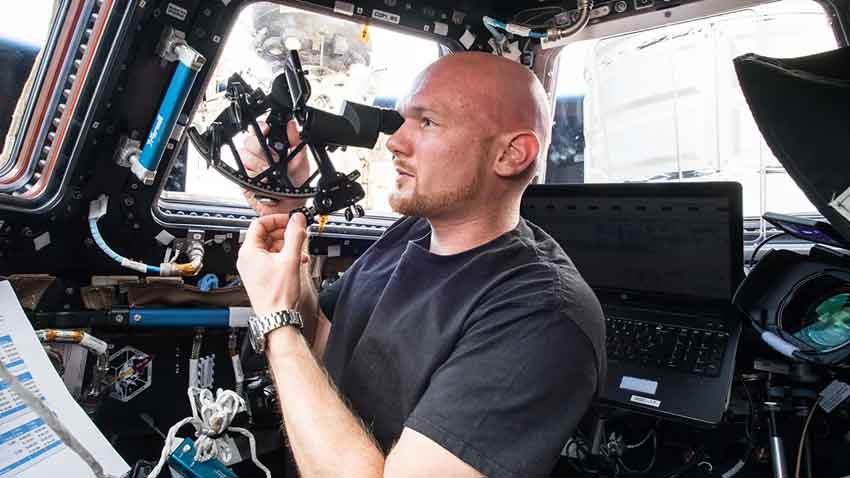
NASA is testing the old technology as humans prepare for longer journeys.
Why an ancient tool still matters
A sextant is a navigation device that measures the angle between stars, planets and other objects in the sky. By using these measurements, astronauts can work out their position without relying completely on electronic systems.
The technology was widely used by sailors centuries ago and later became useful during early space missions. NASA engineers are again studying it because spacecraft travelling farther from Earth may have fewer ways to depend on Earth-based navigation.
“The further and further we go out, the less and less we can rely on some of the Earth-based navigation technology,” such as satellites, says Greg Holt, the navigation system manager for the Orion Spacecraft and its Artemis missions to the Moon. “And so you now have to fall back more and more on what I would call the classical navigation techniques. And some of those now harken back to the way navigation was done way back in the 16th, 17th, 18th Centuries,” he explains.
Stars could provide a backup route
In traditional navigation, sailors looked at stars to determine their location and direction. The same basic method could become important in deep space because stars may remain available when other navigation systems stop working.
“In that age of classical navigation, “you actually had to look at the stars to figure out where you were, and figure out your orientation relative to those celestial bodies,” he says. These are skills that can be crucial in deep space “because those are some of the only references you have once you get far away from Earth”.
Holt said celestial navigation could provide astronauts with an important emergency option. “We want to make sure that [the astronauts] have a way to safely navigate their way back home, if for some reason they lose communication with the Earth”.
NASA tested the sextant in space
In 2018, Holt’s team asked International Space Station astronauts Serena Auñón-Chancellor and Alexander Gerst to test a handheld sextant. They took measurements using the device while relying on their eyesight and careful handling.
“We had crew members demonstrate the use of a manual sextant, as an emergency means of back-up navigation to get the crew home from the Moon, if they had in fact lost communication,” says Holt. “Because if you lose communication, you also lose that radio navigation link with the Earth, and you’re on your own at that point.”
NASA had already explored similar methods during the early years of human spaceflight. In the 1960s, engineers adapted traditional star navigation for spacecraft, although astronauts initially had doubts about whether the technique would be accurate enough.
Old technology proved its value
Neil Armstrong, the first person to walk on the Moon, once raised concerns about whether astronauts could navigate independently if communication with Earth was lost. “one of the things that I was concerned with at the time was whether our navigation was sufficiently accurate [...] if we lost communication with Earth, for whatever reason, could we navigate by ourselves using celestial navigation? We thought we could, but these were undemonstrated skills.”
Those concerns were eventually answered as astronauts successfully used celestial navigation during early space missions. During Gemini XII in 1966, Buzz Aldrin used a handheld sextant and chart after a radar problem affected the spacecraft.
The method also became important during the troubled Apollo 13 mission in 1970. Jim Lovell used the Earth as a visual reference during the journey home, helping the crew maintain their course.
NASA has continued preparing for possible navigation failures as it plans new missions to the Moon and beyond. During the Artemis II mission, a handheld emergency sextant was kept ready as a backup navigation tool.
The sextant shows that old technology can still have a place in advanced space missions. Unlike electronic navigation systems, it can use visible objects such as stars as natural reference points.
For astronauts travelling far from Earth, having a backup could be extremely important. If communication, computers or other navigation equipment fail, knowing how to read the stars could provide another chance to find the way home.
Also read: Philippine couple ties the knot in flood-hit church despite rising waters
Also read: NASA launches Roman telescope for a stunning cosmic survey


