

NASA launches Roman telescope for a stunning cosmic survey
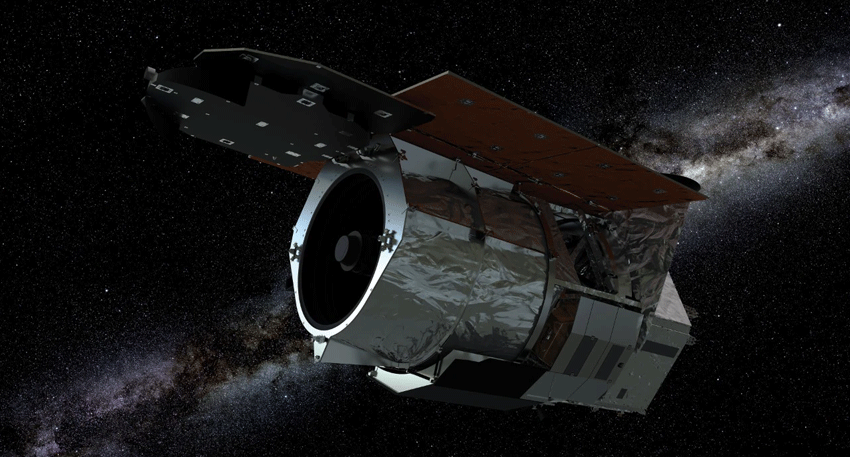
NASA Roman telescope begins major space mission
NASA has started a major new space mission with the launch of the Nancy Grace Roman Space Telescope, a powerful observatory designed to study some of the universe’s biggest mysteries.
The telescope was launched from NASA’s Kennedy Space Center in Florida aboard a SpaceX Falcon Heavy rocket. It lifted off shortly after sunrise under clear skies.
The mission is planned to last five years, although NASA says the telescope has enough fuel to continue operating for another five years if conditions allow.
The roughly $4 billion observatory will travel to an orbital location about one million miles, or 1.6 million kilometres, from Earth.
From there, it will examine the universe on a much wider scale than many earlier space telescopes.
Scientists hope the mission will provide new information about dark energy and dark matter. It will also test how gravity behaves across extremely large distances.
Another important goal is finding planets outside our solar system, known as exoplanets.
Telescope designed for a wider view of space
The Roman telescope has a different role from other famous observatories such as the James Webb Space Telescope and Hubble Space Telescope.
NASA scientists describe Webb as a telescope that can look deeply into distant parts of the universe, while Roman is designed to capture much wider areas.
Roman is expected to survey the entire Milky Way in about one month. By comparison, scientists say Hubble would need around a century to carry out a similar survey.
This wide field of view could allow researchers to study huge numbers of galaxies and stars more efficiently.
The telescope’s first 90 days in space will be focused on testing its systems and preparing its instruments for scientific work.
NASA expects Roman to send its first high-resolution images before the winter holidays.
Project scientists say the launch marks the end of years of engineering work but opens a new chapter for astronomers.
The observatory is expected to work alongside Webb and Hubble rather than replace them.
From spy satellite idea to cosmic explorer
The history of the Roman telescope is unusual. The spacecraft was originally designed for a US intelligence programme involving advanced spy satellites.
The National Reconnaissance Office, which oversees major US reconnaissance satellite programmes, donated the telescope hardware to NASA in 2012 after the original programme was cancelled.
NASA then redesigned and repurposed the equipment for astronomical research.
The transformation turned technology originally intended for observing Earth into an instrument capable of studying the distant universe.
The telescope is named after Nancy Grace Roman, a NASA astronomer who played an important role in developing the agency’s space astronomy programme.
NASA officials expect the new observatory to become one of the agency’s major scientific instruments.
Its launch also came nine months earlier than originally scheduled, according to NASA.
Also Read:Internet suspension: PM says services will be restored in two days
Roman telescope will map billions of galaxies
One of Roman’s most important tasks will be creating a detailed three-dimensional map of the universe.
Its main survey is expected to cover more than two billion galaxies and will take more than a year to complete.
Scientists will use this huge collection of data to better understand how the universe has changed over billions of years.
The universe began with the Big Bang around 13.8 billion years ago and has continued expanding ever since.
Scientists have found that this expansion is accelerating. They believe dark energy could be responsible, although its true nature remains unknown.
Dark matter is another major mystery.
It cannot be directly seen, but scientists know it exists because of the gravitational effects it appears to have on galaxies and stars.
Ordinary matter, including stars, planets, gas and dust, makes up only about 5% of the universe. Dark matter is estimated at about 27%, while dark energy may account for roughly 68%.
Roman will help scientists study the effects of both dark matter and dark energy across enormous distances.
Thousands of new planets could be discovered
The mission will also conduct one of the largest searches ever carried out for exoplanets.
Scientists expect Roman to discover thousands of planets beyond our solar system.
The telescope could also provide the first large-scale statistical picture of planetary systems similar to our own.
This information could help researchers understand how common different types of planets are and how planetary systems develop.
The mission could therefore answer questions that extend beyond the study of distant galaxies.
It may also help scientists understand where planets form and how systems like our solar system evolve.


