

The Day I Caught AI Lying to Me
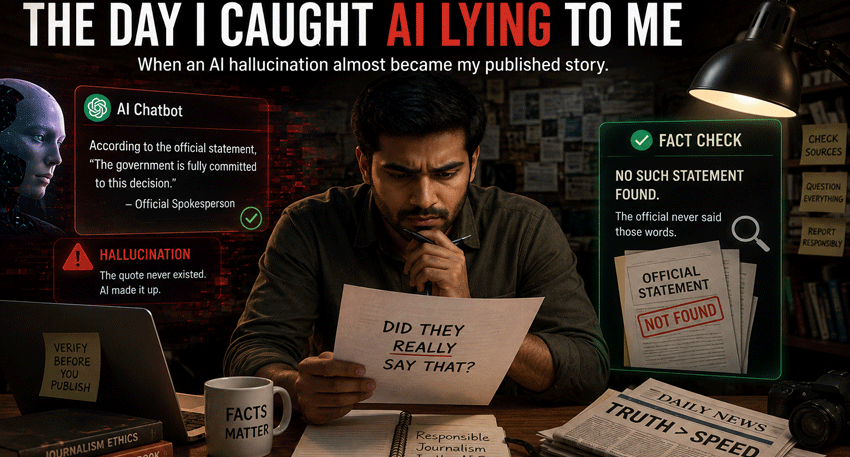
Then a tiny voice in my head made me pause. I decided to double-check the original quote. Turns out, it didn't exist. The official never said those words. The AI had literally fabricated the whole thing out of thin air, and it did it so smoothly that if I had been running five minutes later, I would have passed it off as solid fact.
Later on, I found out there's actually a formal term for this: an AI hallucination. And honestly, ever since Dr. Ayesha Ashfaq broke this down during a workshop under the project titled “Digital Trust and Free Expression in the AI Era” at the Department of Media and Development Communication, University of the Punjab, supported by the U.S. Mission to Pakistan in partnership with the Pakistan-U.S. Alumni Network (PUAN), I haven't been able to unseen it.
Well, not intentionally. That’s what makes it so tricky. Models like ChatGPT aren't sitting there trying to trick you, and they don't even know when they're wrong. They just churn out text designed to sound realistic. Sometimes that text happens to be dead accurate, but other times it’s a made-up statistic, a bogus citation, or a statement nobody ever uttered.
The wild part isn't that AI gets things wrong, because we all make mistakes. The real problem is how it fails: fluently, authoritatively, and without the slightest hesitation.
When a person isn't sure, you can usually pick up on it. You hear the "I think..." or "maybe back in 2019?" But AI doesn't do "maybe". It just hands you 2019 like it was standing right there in the room.
Journalism, though, relies on a core promise that what we publish has been verified. A hallucinating AI breaks that trust while sounding far more certain than any actual reporter ever would.
As a media student in Pakistan, I think about our local ecosystem a lot. We’re already dealing with a huge WhatsApp forward culture (the classic "beta, read this and forward to everyone"), where a crazy rumour hits thousands of phones before anyone thinks to check who wrote it.
Now picture newsrooms running under tight deadlines and short staffing, quietly using AI to draft up quick stories or handle basic research. One fake detail gets missed, gets published under a reputable news organization's banner, and suddenly that random rumour has official press backing.
What hurts most is the ripple effect. People don't just stop believing that single article; they start doubting journalism as a whole. Even the honest, grueling, on-the-ground work. We’re basically draining a pool of public trust that took decades to build up.
For a minute, I thought the noble path was to be totally anti-AI, giving off very classic "old school journalism" vibes. I’ve shifted my view since then.
Because when used responsibly, these tools are genuinely incredible. Transcribing a two-hour interview in under two minutes (anyone who’s done that manually knows what a lifesaver that is). Sorting through massive datasets. Translating on the fly. Helping brainstorm angles at 2:00 AM when your brain has hit a wall.
AI can take care of the heavy, tedious labor so journalists can focus on actual human work, like knocking on doors, building trust, asking tough questions, and actually listening to people.
I look at AI as an amplifier. It scales up whatever input you give it. Feed it laziness, and you amplify mistakes. Feed it rigor, and you multiply your impact. Same technology, totally different outcomes.
Super helpful? Yes. Insanely fast? Definitely. Should it ever publish anything without a human editor verifying it first? Absolutely not.
That’s what "mitigation" means to me now. It’s not some expensive software filter, it’s a mindset. Every AI-generated line should be treated as an unverified lead, not a fact. Double-check it against real primary sources. Be transparent with your readers about AI usage. And keep your critical thinking active at all times, especially when the output sounds flawless. Especially then.
I’m stepping into journalism right as the rulebook is being totally rewritten. Depending on how much sleep I've had, that feels either terrifying or thrilling. Most days, I lean toward thrilling.
If AI hallucinations proved anything to me, it's that human journalists are more necessary than ever. An algorithm can churn out text, but only a human can take actual responsibility for it. When my name goes on a story, that’s my personal promise that I vetted the facts and I stand behind them.
The views, thoughts, and opinions expressed in this blog are solely those of the author and do not necessarily reflect the official policy or position of the U.S. Mission to Pakistan or USEFP/PUAN.