

How the Lack of AI Checkers Fake Us All?
One of the most prominent and first voice clone theft was the "UK energy firm voice clone theft" occurred in 2019, where scammers and fraudulent used the cloned voice of German Parent company's CEO to trick its UK based subsidiary company's CEO to transfer $243,000 into secret accounts. Academic researchers cite this case as the real-world class AI voice fraud case. Researchers also highlighted in their researches that the tone, pacing, and accent of the cloned voice of Germany's CEO was so perfect that IT security software had zero capacity to identify the voice layers in the cloned voice to detect, whether is it deepfake or not?
Deepfake victimisation of the general public, media industry related people like main stream media actors, actresses, TV presenters, musicians and You Tubers and over 4000 famous individuals are directly affected and become victims of non-consensual deepfake pornography, (The Guardian), and in my opinion it is a huge crime because usage of someone's images, videos and audios without their consent for any purposes is a wrongful act and more worst when it is used for malicious or bad intents and purposes.
To Sum up, AI deepfake technology is best for better understanding of history, museums, online teacher or instructor, advertisers, trainers, coaches, political communication, etc., again I repeat if this technology used positively. Negative and malicious use of this deepfake technology is contagious, causing harm and is lethal for mental health commonly rising up depression and fear among the victims of deepfakes and general public.
In fact, a lot of positive and negative aspects of AI deepfake technology has been discussed above and it's wrong usage by the public but now the most important thing is what are the solutions? How to counter the products (AI deepfake videos, images etc.,), emerging from this deepfake technology and its negative role in the society. This needs to be discussed and regulated through legislation, through AI deepfake technology awareness’, ethical considerations while using this technology, among the general public.
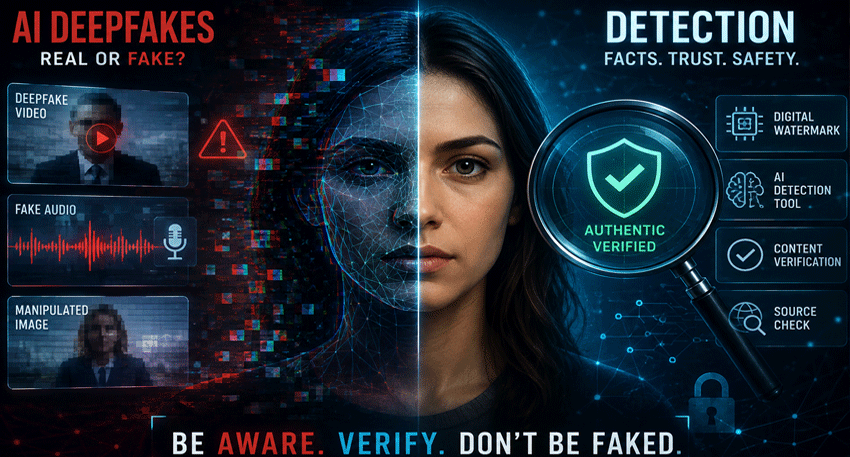
First solution to counter malicious and unethical deepfakes, is to embed cryptographic metadata in the AI deepfake technology. Another way to counter AI deepfakes is to deploy AI detection software in social media apps, websites etc., Train deepfake learning classifiers to spot deepfakes and generative adversarial network and deep model artifacts in imagery and audio. Mandate to disclose tags, and require users and creators to flag AI generated deepfakes, or fully generated deepfakes images, videos and audios during the upload process on the social media sites. Other ways to check whether the image, video is AI generated deepfake or not, always check for unnatural textures, warped background geometries, mismatched earrings, or floating elements. Look for inconsistent light sources, missing reflections, or physically impossible shadows. Cross-reference sensational images or videos with trusted, established news outlets before sharing. Listen closely for robotic inflections, sudden background silence, or unnatural breathing patterns in speech. In conclusion, flagging AI generated malicious deepfake is now the major challenge masses are facing currently with the rise of AI deepfake technology. Introduction of systematic metadata tools, deepfake flagging software' and upgraded digital watermarks are needed to thwart digital exploitation and manipulation by AI deepfake technology. When, who and how it will be developed and upgraded, it is a million-dollar question which needs to be answered.
The views, thoughts, and opinions expressed in this blog are solely those of the author and do not necessarily reflect the official policy or position of the U.S. Mission to Pakistan or USEFP/PUAN.