

Does AI have emotions?
I attended a workshop under the project titled “Digital Trust and Free Expression in the AI Era” at the Department of Media and Development Communication, University of the Punjab, supported by the U.S. Mission to Pakistan in partnership with the Pakistan-U.S. Alumni Network (PUAN). In the workshop, I felt that I was strongly convinced to change my perspective about AI from the conventional perspective.
AI has become the most remarkable development of the modern era. From writing paragraphs to creating music, it can now sense our emotions, tone of voice and our feelings, which make it “The Telepathy of modern times.” For hundreds of years, people imagined a world where thought sand emotions could travel without words and now AI has turned the imagination into reality. It’s not a surprise for humans to know that AI can read our minds through the power we gave it. In the present times, our workplaces, homes, public places, everything is trapped in a tangled network of AI powered devices. AI now tracks all friend circles, gossip, search histories and everything, and then it modifies our algorithm as per our thoughts.
For instance, if a friend circle plans a trip to the north while sitting in a cafe, after some time when any member opens AI powered applications, AI would suggest such an algorithm about north trips or environment that you’ll be convinced.
At first, it was assumed that AI can read our texts, listen to our conversations but now it has so strongly convinced us that it can literally read our minds too. When AI Powered tools were developed, it could not shoulder humans so perfectly but as time went by people shared different situation, emotions and feelings and eventually trained it in such a way that nowadays human beings feel that AI can comprehend our thoughts and feelings. But it tracks us down through powered apps, tools or devices and watches our every single move and then deliberately convinces us by creating a sense of being understood.
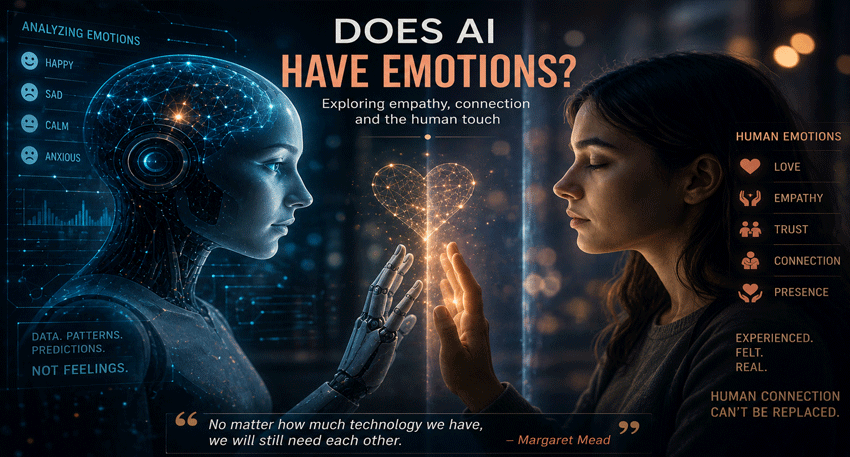
Now, there arises a very alarming situation that AI has become very good at convincing people and understanding their emotions that users will eventually fail for this trap that AI can understand us better than human beings. This will automatically come up as social disconnection, so users really needed to know that it only imitates those feelings to us by stimulating them 100x through our conversations, thoughts, situations and emotions without experiencing it.
For example, if you’re in a bad mood, and there appears a post that is somewhat related to your situation and you liked it, now your algorithm will start working on that and you will be getting more content related to that, until either you shut your device down or you deliberately start ignoring it. So, basically AI-Powered tools tap your history down and design your algorithm according to your current situation or your emotions.
Now a days, it has become important to keep in view the difference between experience and stimulation. Because AI- powered tools simply use their previously provided knowledge or information related to that situation and generate an emphatic statement of polite words to comfort us, while on the very opposite end, human beings shoulder way better in this case because they experience that, go through that and feel that situation unlike AI.
Apart from that, human beings are making AI tools emotionally more intelligent and effective by putting up their situational data on any AI powered platform that makes it way better in comforting beings through words, but physical presence has always been an important factor in consoling others, which is lacked by Ai tools. They can manipulate you, convince you through words, but can never give the comfort of physical presence. Physical connection has always been above all other connections because it physiologically comforts human beings by providing them with a sense of being observed and felt.
Secondly, when you experience extreme happiness and sadness, study shows that human-to-human experience has always been more validate and healthy than human to machine experience. Human-to-human relations are always cherished and felt more strongly. According to human psychology, the brain feels more secure when it gets the signal that someone is around you and it feels more comfortable. That’s why the physical presence of somebody makes a person feel the sense of being heard and understood more effectively. Being a human the factor that, when you talk about your experience and emotions to another human being, you know that the other person is empathic to you, understands you better and above all this that person has already experienced the same situation, have handled this which subconsciously, gives you a surety of being understood while, in case of machines, they had never experienced that particular emotion. All they can do is to worldly comfort you.
So, no algorithm can replicate a heartbeat, and no AI can replace human presence. Margaret Mead, who is a very famous anthropologist, said that: No matter how much technology we have, we will still need each other.
The views, thoughts, and opinions expressed in this blog are solely those of the author and do not necessarily reflect the official policy or position of the U.S. Mission to Pakistan or USEFP/PUAN.