

Can We Trust What We See? The Challenge of Truth in the AI Era
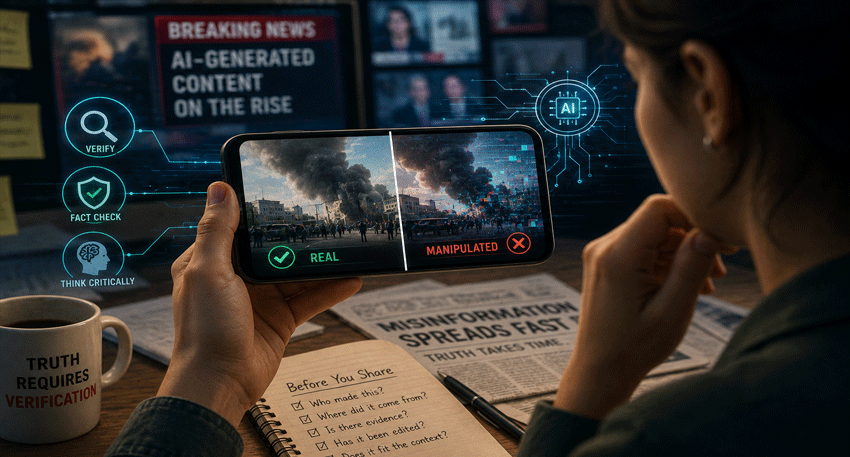
I attended a workshop under the project titled “Digital Trust and Free Expression in the AI Era” at the Department of Media and Development Communication, University of the Punjab, supported by the U.S. Mission to Pakistan in partnership with the Pakistan-U.S. Alumni Network (PUAN) where we explored one of the most important questions of our digital age: Can We Trust What We See on the Internet? For generations, to see was to believe. A photo can be proof, a video recording can resemble reality, a news report can assist audiences in understanding what is going on afar from them. But artificial intelligence is challenging that assumption today. In an age where images, videos, audio, and even entire stories can be generated or altered within seconds, the question is no longer simply What do we see? It is Can we trust what we see?
The rapid development of artificial intelligence has changed the digital information environment. AI tools can help journalists research, summarise, translate, brainstorm and create content more efficiently. Such opportunities can speed up and make journalism more accessible. But those same technologies also can create serious challenges for truth and public trust. Content created by artificial intelligence can be convincing even if it doesn’t reflect the truth.
One of the important issues discussed in the workshop was AI hallucination. Sometimes artificial intelligence systems may generate information that sounds confident and convincing but is factually incorrect. This is especially troubling when dealing with journalism, where an inaccurate statement can quickly pass from a newsroom to social media and then reach thousands or millions of people. The problem is not always that the information looks obviously false. Sometimes, the greatest danger is that it looks believable.
The issue is more complicated with deepfakes and manipulated media. Now you can use artificial intelligence to create realistic looking images, videos and audio that make it look like people are saying or doing things they never said or did. Such content can harm reputations, influence public opinion, and create turmoil in sensitive situations. And as viewers struggle to distinguish what is real from what is artificially generated, faith in digital content itself can start to erode.
But AI is not the only game in town for misinformation propagation. Human behaviour also has an important part to play. Social media rewards quick, engaging, viral content. People may share emotionally shocking posts before even reading the source or context. A headline can be delivered without reading the full story, an old photograph can be presented as a recent event. In such an environment, misinformation does not need to be sophisticated to be influential; it just needs to be shared quickly.
Verification and fact-checking have never been more crucial. One of the key takeaways from the workshop is that digital content should not be trusted simply because it looks professional or is hosted on a familiar platform. As journalists and digital creators, they need to ask where information comes from, evaluate the credibility of sources, compare claims with reliable evidence and verify images, videos and other media before presenting them as facts.
The responsibility is particularly important for journalists. Journalism in the past has been built on ideals such as accuracy, fairness, accountability and verification. AI should not undermine these principles, but rather strengthen them. There’s no doubt that artificial intelligence can be a tool for journalists, but it can’t replace journalistic responsibility. A journalist who simply accepts AI-generated information at face value and does not fact check could convert an efficient tool into an efficient source of misinformation.
The question is also directly related to freedom of expression. Digital platforms have opened up new opportunities for ordinary users to speak, publish, participate and share information as never before. This openness is a good thing, but freedom of expression also requires responsible participation. Responsible communication is not about shutting people up or limiting legitimate opinions. But it means understanding that the ability to publish something doesn’t mean it’s true.
The responsibility is not only on the journalists. Roles in digital trust protection include technology companies, social media platforms, content creators, educators and audiences. The system allows users to think twice before posting questionable content. Creators can tell the difference between facts and opinions and refrain from presenting unverified claims as truth. Journalists can still apply exacting standards for checking facts, and platforms can strive to develop better mechanisms for spotting content that is misleading or has been manipulated.
The theme of the workshop, responsible digital storytelling, also brought to light an important truth: every piece of content contributes to our digital footprint. Whether we are journalists, students, influencers or everyday social media users, what we post can influence how others see our credibility. The Story Sprint Challenge has taught us that content can be fast and creative, but that good storytelling requires more than just an appealing story. It means asking if the story is accurate, fair, well-sourced and responsible to audience.
In the era of AI, then, seeing should no longer automatically equal believing. The answer is not to be suspicious of everything we find online, but to develop a practice of informed scepticism. We should keep an open mind to information but also question: Who is this by? Where did it come here? Is there any good evidence? Is the claim independently testable? Has the image, audio or video been manipulated?
Trust in digital spaces cannot survive on appearance alone. It should be grounded in evidence, ethics, media literacy and responsible content creation. AI might make it easier than ever to dream up believable stories, but it’s up to us to ensure that what we create, consume and share still adheres to the truth.
The views, thoughts, and opinions expressed in this blog are solely those of the author and do not necessarily reflect the official policy or position of the U.S. Mission to Pakistan or USEFP/PUAN.