

Lahore’s air pollution level eight times higher than WHO guideline
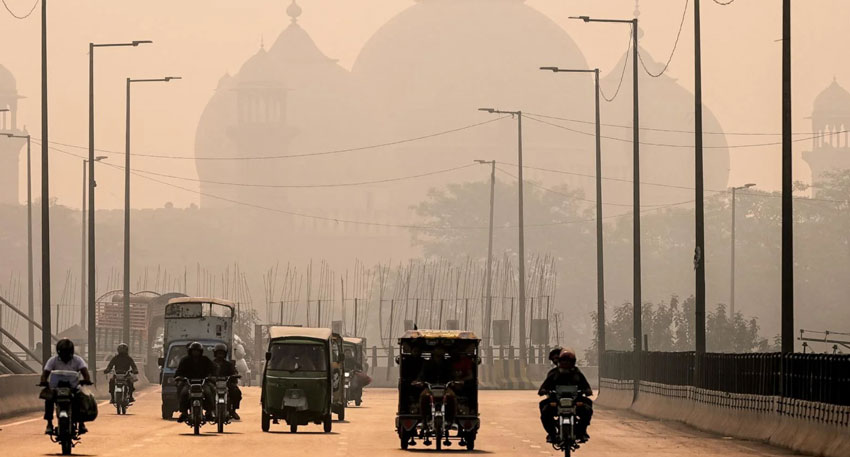
The Pakistan Air Quality Initiative (PAQI) report also found thousands of likely crop-residue fires across Punjab. However, it said there was not enough evidence to blame Diwali fireworks in India for Lahore’s poor air quality.
Punjab records thousands of crop-residue fires
Satellite data detected 16,714 likely crop-residue fires in Punjab between October 1 and November 9. The number remained almost unchanged compared with the same period last year.
Overall, satellites detected 18,825 fires across the province during this period. Around 89 per cent of these incidents were classified as likely crop-residue burning.
The highest number of fires was recorded on November 1, when satellites detected 1,102 incidents. The report said the number of likely crop-residue fires was 8 per cent above the average recorded between 2020 and 2025, but 1 per cent lower than in 2025.
Sheikhupura reported the highest number of fires at 2,559. Jhang recorded 2,192, followed by Okara with 2,062, Hafizabad with 1,893 and Gujranwala with 1,417.
These five districts accounted for 54 per cent of all recorded fire detections. The findings highlight the scale of crop-residue burning across several parts of Punjab.
Lahore’s PM2.5 levels remain above safety limits
Lahore’s average PM2.5 concentration reached 126 micrograms per cubic metre during the reported period. This was eight times the WHO guideline value and 11 per cent lower than the average recorded during the same period in 2025.
The city also exceeded Pakistan’s 24-hour National Environmental Quality Standards (NEQS) on all 40 days for which valid air quality data were available. This means pollution levels remained above the national limit throughout the period covered by the available readings.
The report also found a link between fires in areas located upwind of Lahore and higher pollution levels in the city. On days when air moved towards Lahore from areas where burning was taking place, the average PM2.5 level reached 175 micrograms per cubic metre.
On other days, the average stood at 93 micrograms per cubic metre. This difference suggests that smoke from crop-residue fires may contribute to worsening air quality in the city.
A similar pattern appeared in other cities. Multan recorded an average of 203 micrograms on days affected by air movement from fire-hit areas, compared with 88 micrograms on other days.
In Bahawalpur, the average reached 125 micrograms on affected days and 65 micrograms on other days. However, the report warned that these figures alone could not establish exactly how much crop-residue burning contributed to urban pollution.
Weather conditions also add to pollution
The report said crop-residue burning was not the only reason behind the high pollution levels. Stagnant weather and weak air movement also played a role by allowing pollutants to remain trapped near the ground.
When air does not move properly, smoke and other harmful particles can build up over cities. This can make pollution worse even when the number of fires does not increase.
The report found that pollution levels were higher when winds carried air from areas where fires had been detected. However, it cautioned that weather conditions and other pollution sources also needed to be considered.
Report questions link between Diwali fireworks and Lahore smog
The PAQI report also examined whether fireworks during Diwali celebrations in India on November 8 had affected air quality in Punjab. It found that easterly winds carried air from Indian territory towards Pakistan during the night.
Researchers examined 48 air movement paths reaching Lahore, Kasur and Sialkot between 9pm on November 8 and midnight on November 10. Of these, 45 had passed over Indian territory during the previous 12 hours, mainly near Tarn Taran, Amritsar and Jammu.
Despite this movement of air, the report said there was not enough evidence to link Lahore’s poor air quality after Diwali directly to fireworks across the border. It also noted that the available findings could not confirm how much fireworks contributed to pollution.
Lahore’s average PM2.5 concentration between 6pm on November 8 and 1am on November 10 was 234 micrograms per cubic metre. This was 10 per cent higher than the average recorded during the same hours over the previous seven days.
The report shows that crop-residue burning is an important concern for Punjab’s air quality, but it is not the only cause of pollution. Weather conditions and other sources of smoke and dust can also make the situation worse.
Blaming pollution on one event without strong evidence can hide the real causes. Better monitoring, control of crop-residue burning and action against other sources of pollution are needed to improve the air quality.
Also read: Why HEC introduces new HAAT mandatory test for PhD admissions


