

What will Pakistan’s first astronaut do in space? Zeeshan Ali’s historic mission explained
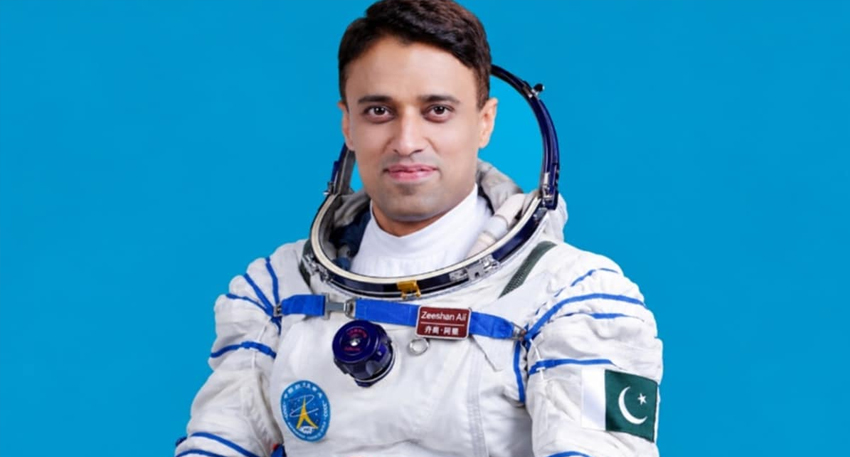
The Shenzhou-24 Mission has given Pakistan an opportunity to participate in scientific research conducted in space.
Muhammad Zeeshan Ali is serving as a payload specialist, meaning his main responsibility is to carry out scientific experiments.
During his stay, he will work alongside Chinese astronauts Tang Hongbo and Wu Yi. His research will focus on microalgae, photosynthetic bacteria and quinoa seeds to understand how living organisms and agricultural materials behave in space.
1. Studying Microalgae That Could Produce Food and Oxygen
One of the major tasks in the Zeeshan Ali Space Experiments involves cultivating microalgae and studying photosynthetic cyanobacteria.
These tiny organisms use light to produce energy through photosynthesis. Scientists are exploring whether they could support future space missions by helping produce oxygen and potentially providing food for astronauts.
This research is important because long space journeys require reliable sources of food and oxygen. Growing useful organisms inside spacecraft could reduce astronauts’ dependence on supplies brought from Earth.
2. Testing How Space Affects Quinoa Seeds
Another important experiment involves quinoa seeds, a crop known for its nutritional value and ability to grow in different environmental conditions.
The Pakistani Astronaut in Space will help study how microgravity and space radiation affect these seeds.
Scientists want to understand whether quinoa can be used for future space agriculture. The findings could help researchers explore ways to grow food during long journeys to the Moon and Mars.
3. Working on Pakistan-China Scientific Research
The Shenzhou-24 Mission also includes joint research projects involving biotechnology and materials science.
Pakistani universities and research institutions have contributed to these experiments as part of scientific cooperation between Pakistan and China.
The overall mission involves around 90 scientific experiments and technology tests. However, these are part of the wider mission, and not all will be conducted by Muhammad Zeeshan Ali.
The research is taking place in the laboratory modules aboard the China Tiangong Space Station.
Read Also: Pakistan’s astronaut gets a taste of home in space with special halal menu
4. Understanding How Living Organisms Survive in Space
Another important purpose of the research is to understand how living organisms respond to microgravity.
On Earth, plants and microorganisms grow under normal gravitational conditions. In space, the absence of normal gravity can affect their growth and development.
Through his experiments, Muhammad Zeeshan Ali will help scientists collect information about how these organisms behave in the space environment.
This research could support future systems that allow astronauts to produce some of their own food and oxygen during longer missions.
5. When Will Zeeshan Ali Return to Earth?
Unlike Chinese astronauts Tang Hongbo and Wu Yi, who are beginning a longer stay aboard the station, Ali is participating in a short-duration mission.
He is expected to spend around five to ten days in space before returning to Earth aboard the Shenzhou-23 spacecraft with two members of its crew.
His visit is part of the crew rotation and research activities taking place aboard the station.
Why Is This Mission Important for Pakistan?
The journey of Pakistan’s First Astronaut is an important opportunity for the country's scientific community.
The mission allows Pakistani researchers to participate in experiments that could support future developments in agriculture, biotechnology and space exploration.
The Zeeshan Ali Space Experiments may also encourage students and young scientists in Pakistan to explore careers in scientific research and aerospace technology.


