

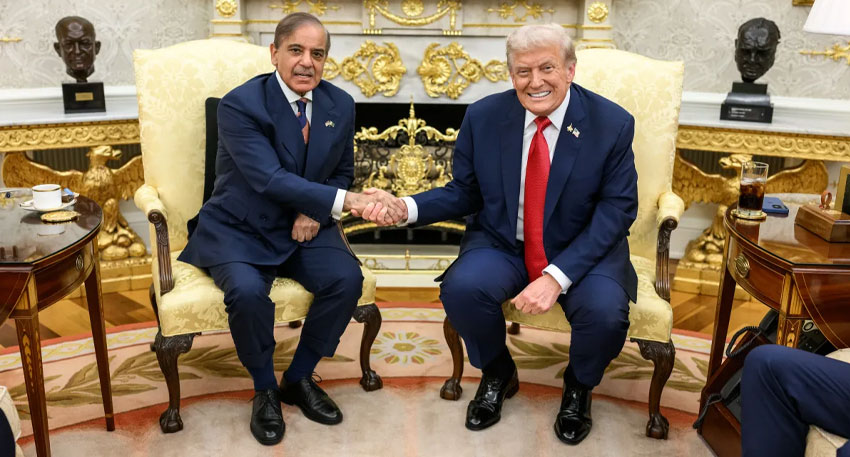
The Donald Trump Islamabad visit linked to Iran deal has raised global attention.
The US President said he is willing to travel to Pakistan if an agreement with Iran is finalized. His statement has sparked discussions about possible diplomatic developments.
Donald Trump acknowledged Pakistan’s contribution in regional matters. He said, “Pakistan has played a very strong role”.
He also praised the country’s leadership in his remarks. He said, “Pakistan’s Prime Minister and Field Marshal are very impressive personalities”.
The statement reflects a positive tone in US-Pakistan relations. Analysts believe such remarks could improve diplomatic engagement between the two countries.
Trump’s possible visit to Islamabad is being seen as a significant development. It may open doors for further cooperation in political and economic areas.
Observers say the Iran deal could play a key role in shaping future regional ties. Pakistan’s involvement may continue to influence major international discussions.
Read more: MG Motor teases new IM electric car in Pakistan – powerful features revealed
This statement shows a softer tone in relations. If the visit happens, it could improve ties between both countries.
On the other side, Pakistan’s Foreign Ministry on Thursday confirmed that the United States and Iran were in discussions – through Islamabad – to hold a second meeting between their negotiators to end their now nearly seven-week war, with a fragile ceasefire announced on April 8 days away from expiring.
But it added that no date had been set for that next round of negotiations, even as Islamabad stepped up a parallel diplomatic push to keep the process alive.
“Who will come, how big the delegation will be, who will stay, and who will go is for the parties to decide,” Foreign Ministry spokesperson Tahir Andrabi told reporters in Islamabad, referring to what upcoming talks might look like. “As a mediator, it’s important for us to keep the talks confidential. We had the details and information of the talks entrusted to us by the negotiating parties.”
Speaking of the first round of talks on April 12 in Islamabad, which concluded without a deal, Andrabi said: “There was neither a breakthrough nor a breakdown.”
The spokesperson confirmed that nuclear issues remained among the key subjects under discussion, but declined to elaborate.
His comments came as Pakistan’s civil and military leadership is travelling across the region in what some observers have begun calling the “Islamabad Process”, reflecting the government’s attempt to frame negotiations as an ongoing diplomatic effort rather than a one-off engagement.
Read more: Vaisakhi Mela: Pakistan welcomes Sikhs from India, around the world
Pakistan’s Prime Minister Shehbaz Sharif arrived in Doha on Thursday, the second stop of a four-day regional tour that began with Jeddah on Wednesday, and will see him visiting Antalya next.
Meanwhile, Pakistan’s Chief of Defence Forces (CDF) Asim Munir arrived in Tehran on Wednesday with a delegation that included Interior Minister Mohsin Naqvi.
Munir was received at the airport with a warm hug from Iranian Foreign Minister Abbas Araghchi, who said he was “delighted” to welcome the field marshal and expressed gratitude for Pakistan’s “gracious hosting of dialogue”.
On Thursday, Iranian Parliamentary Speaker Mohammad Bagher Ghalibaf, who led Tehran’s delegation at the Islamabad talks, also met Munir.
Reza Amiri Moghadam, Iran’s ambassador to Pakistan, said at an event in Islamabad that Tehran would not consider any venue other than Pakistan for talks with Washington.
“We will do talks in Pakistan and nowhere else, because we trust Pakistan,” he said.
Muhammad Faisal, a Pakistani security analyst and scholar at the University of Technology Sydney, said the parallel outreach reflected a deliberate division of labour.
“Pakistan’s strategy appears to be dual-tracked: PM Sharif is reassuring Gulf allies and attempting to build a broader support coalition, while CDF Munir is engaged in hard negotiations between the two sides to narrow gaps between Iran and the US, with an eye on extending the ceasefire and reaching a broader understanding,” he told Al Jazeera.


