

Pakistan, Saudi Arabia and Turkiye move to operationalising Makkah Defence Alliance
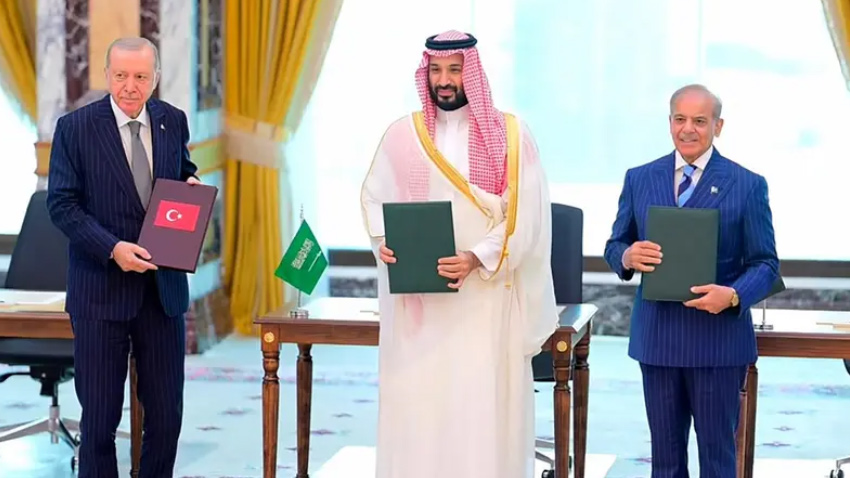
The Foreign Office (FO) said retired Lieutenant General Nauman Mahmood, the alliance’s first secretary general, is expected to assume his responsibilities in Riyadh soon. The alliance includes Pakistan, Saudi Arabia and Turkiye and aims to strengthen their collective defence.
Makkah Defence Alliance prepares for next phase
Nauman Mahmood was appointed as the first secretary general of the Makkah Defence Alliance on September 23. The appointment followed the signing of the Makkah Joint Defence Agreement by Pakistan, Saudi Arabia and Turkiye on August 7.
Under the agreement, an armed attack against any one of the three countries can be treated as an attack against all members. This arrangement aims to strengthen their joint security and defence capabilities.
Speaking at the weekly press briefing, FO Spokesperson Sajjad Haider Khan said the three countries would jointly decide when to hold the alliance’s meeting. He added that the secretary general was expected to begin his duties in Riyadh soon.
The alliance has attracted greater attention because of growing security concerns in Saudi Arabia. Yemen’s Houthi rebels have carried out attacks against the Kingdom, including a deadly strike that forced Riyadh’s international airport to close for two weeks last month.
Pakistan assures support for Saudi Arabia
Pakistan has assured Saudi Arabia that it will provide “whatever support is needed” to help defend the Kingdom against Houthi attacks. Military spokesperson Lieutenant General Ahmed Sharif Chaudhry made this statement in October.
However, the Director General of Inter-Services Public Relations (ISPR) clarified that the alliance was not created to attack any country. He said all three members were “absolutely clear […] that this alliance has no offensive intent; it is purely defensive”.
The military spokesperson also explained Pakistan’s position on collective defence. He said: “Pakistan is giving very strong signals that this collective deterrence is at play, has already been actualised and we will take all necessary steps for the security and territorial integrity of the Kingdom of Saudi Arabia and the Haramain Sharifain (The Two Holy Mosques).”
Pakistan and Saudi Arabia already have a separate Strategic Mutual Defence Agreement. The Makkah Joint Defence Agreement expands this security arrangement by bringing Turkiye into the trilateral partnership.
Turkiye approves defence agreement
The Turkish parliament has approved a bill ratifying the Makkah Joint Defence Agreement. This decision has cleared an important step towards bringing the three-country security pact into force.
Pakistan and Saudi Arabia had already completed their ratification processes, according to the Foreign Office. The FO explained that each country followed its own constitutional and legal procedures to approve the agreement.
With Turkiye’s parliamentary approval, all three countries have moved closer to implementing the agreement. The appointment of the secretary general is another important step towards establishing the alliance’s working structure.
Pakistan calls for peace through diplomacy
During the briefing, FO Spokesperson Sajjad Haider Khan also discussed tensions involving Iran and the United States. He said Pakistan would continue its efforts to bring both countries towards dialogue and a peaceful settlement.
Khan said Islamabad had managed to bring the two sides together despite their lack of direct contact for several decades. He pointed to the Islamabad Memorandum of Understanding (MoU), signed between the two sides on June 18, as “proof” of Pakistan’s diplomatic efforts.
He added that Pakistan, Qatar and other countries were actively working to support mediation efforts. According to Khan, lasting peace could only be achieved through “political dialogue and diplomacy” rather than military action.
The FO spokesperson acknowledged that negotiations could take time but said diplomatic efforts remained the best way to resolve disagreements. He also described Israel as a “spoiler” in the ongoing US-Iran conflict.
Khan criticised Israel’s expansionist policies and said they were among the major reasons behind regional instability. He added that these ambitions were not limited to Iran, as Palestine, Syria, Lebanon and other countries were also affected.
When asked about the recent US midterm elections, Khan said elections were an internal matter of the United States. He also reaffirmed that Pakistan continued to maintain close relations with Washington.
The Makkah Defence Alliance is becoming an important part of security cooperation between Pakistan, Saudi Arabia and Turkiye. The appointment of its secretary general and Turkiye’s approval of the agreement are important steps towards making it operational.
At the same time, Pakistan is trying to maintain its diplomatic role in the Middle East. The challenge will be to strengthen regional security while supporting dialogue and avoiding further conflict.
Also read: PM Shehbaz seeks 100pc digital payments, targets cashless Pakistan


