

Justice Rizvi takes charge as acting FCC chief justice
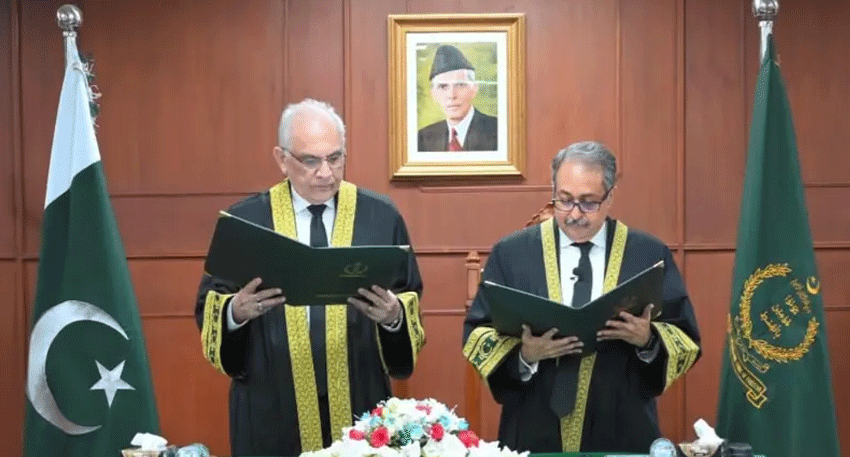
Justice Syed Hasan Azhar Rizvi has assumed the responsibilities of acting Chief Justice of the Federal Constitutional Court of Pakistan.
He took the oath during a formal ceremony after Chief Justice Aminuddin Khan left the country for an overseas visit.
Justice Aamer Farooq administered the oath to Justice Rizvi during the ceremony held at the Federal Constitutional Court.
Several senior officials and legal representatives attended the event, including FCC judges, the registrar and other court officers.
Representatives of the Ministry of Law, the Supreme Court Bar Association and the Pakistan Bar Council were also present.
Justice Rizvi assumes court responsibilities
After taking the oath, Justice Rizvi formally assumed the duties of acting chief justice.
His temporary appointment is aimed at ensuring that the Federal Constitutional Court continues functioning without interruption while the regular chief justice is away.
The acting chief justice will oversee the court’s responsibilities and help ensure constitutional cases and other matters continue to be dealt with in a timely manner.
The ceremony marked the formal beginning of Justice Rizvi’s responsibilities in the temporary role.
The Federal Constitutional Court plays an important role in dealing with constitutional questions and matters connected with the interpretation and application of constitutional provisions.
Maintaining continuity in its leadership is therefore important for the smooth functioning of the judicial system.
Senior judges and legal officials attend ceremony
The oath-taking ceremony brought together senior members of the judiciary and representatives of important legal institutions.
FCC judges attended the event along with the court registrar and other officials.
Officials from the Ministry of Law were also present, while representatives of the Supreme Court Bar Association and Pakistan Bar Council attended the ceremony.
Their presence reflected the importance of the temporary leadership arrangement within the Federal Constitutional Court.
Justice Rizvi’s assumption of charge means the court’s administrative and judicial work can continue during the absence of Chief Justice Aminuddin Khan.
Also Read:Beware of illegal visa network as FIA takes action against govt officers
CJP Afridi meets civil service officers
Separately, Chief Justice of Pakistan Yahya Afridi hosted a delegation of probationary civil service officers at the Supreme Court.
The visit was part of the mandatory exposure programme for officers undergoing their training at the Civil Services Academy.
The delegation was led by Farhan Aziz Khawaja, director general of the academy.
The officers are currently part of the 54th Common Training Programme, which includes visits to important state institutions to help them understand how different branches of government operate.
During the meeting, Chief Justice Afridi discussed important aspects of Pakistan’s parliamentary democracy.
Judiciary’s role in constitutional governance explained
Chief Justice Afridi also explained the principle of separation of powers among the legislature, executive and judiciary.
He highlighted how the three branches have different responsibilities while working within the constitutional framework.
The chief justice explained that the legislature makes laws, the executive implements government policies and laws, while the judiciary interprets the Constitution and ensures legal and constitutional principles are followed.
The session gave the probationary officers an opportunity to learn more about the judiciary and its role in Pakistan’s system of governance.
Such exposure visits are intended to provide civil servants with a practical understanding of the country’s major institutions.


