

Pakistan GDP growth hits 3.7% in FY26, says Aurangzeb
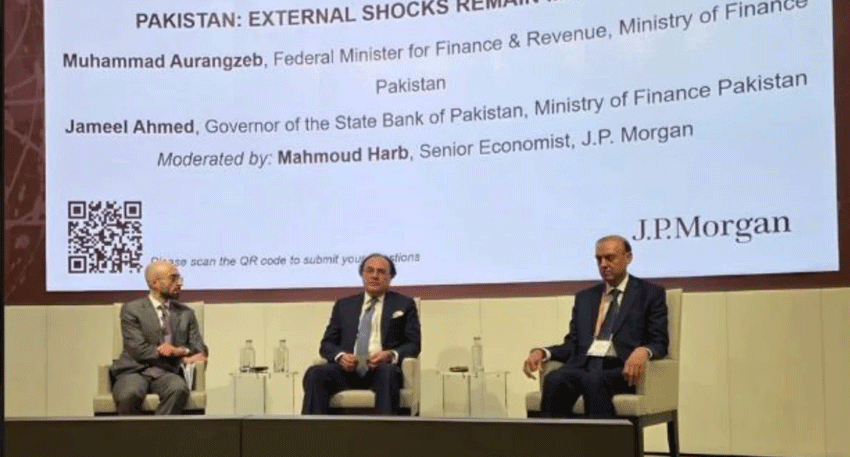
Finance Minister Muhammad Aurangzeb said Pakistan has made progress in restoring macroeconomic stability and rebuilding confidence in the economy.
He was speaking at a J.P. Morgan Emerging and Frontier Markets Opportunities Conference in London on September 18.
The minister said the government now wants to move from economic stabilisation towards stronger investment, capital formation, exports and private sector-led growth.
The conference also attracted strong interest from international investors, with 55 global investment funds holding meetings with the Pakistani delegation.
GDP growth and fiscal position improve
Aurangzeb said Pakistan’s GDP growth recovered to 3.7% in FY26.
He also said the fiscal deficit fell to 2.6% of GDP, which he described as a multi-year low.
Pakistan also recorded a primary surplus for the third consecutive year, according to the minister.
The government has presented these figures as evidence of progress made during its efforts to improve fiscal management and strengthen the external sector.
The Pakistan Economic Survey 2025-26 also reported provisional GDP growth of 3.70% for FY26, compared with 3.18% in the previous fiscal year.
Aurangzeb said the main challenge over the past three years had been to restore stability and rebuild Pakistan’s economic credibility.
He said the next step was to make that stability lasting while creating conditions for stronger and more sustainable growth.
Government outlines six economic priorities
The finance minister outlined six broad priorities for the next phase of the government’s economic programme.
These include maintaining macroeconomic stability, encouraging productivity and export-led growth, and continuing structural reforms.
The government also wants to move from dependence on aid towards greater trade and investment.
Another priority is expanding access to finance for businesses, farmers and households.
Aurangzeb also highlighted digitalisation and emerging technologies, including blockchain and Web 3.0, as part of Pakistan’s future economic strategy.
The government says the new approach is intended to reduce reliance on short-term, consumption-driven expansion.
Instead, it wants investment, productivity, exports and private-sector activity to play a larger role in economic growth.
Focus shifts towards investment
Aurangzeb said the government wants economic stability to become a foundation for increased investment.
He stressed that public finances alone cannot provide all the capital required for Pakistan’s next stage of economic expansion.
According to the minister, private capital will therefore need to play a greater role in financing businesses and productive activities.
The government is also working to expand access to finance for small and medium-sized enterprises, agriculture and housing.
The aim is to connect improved macroeconomic conditions with greater credit availability and investment in the wider economy.
This marks a shift in emphasis from simply managing economic pressures towards encouraging longer-term economic activity.
Debt management and capital markets
The finance minister also highlighted changes in Pakistan’s sovereign debt management.
He said the government had taken steps to extend domestic debt maturities and reduce refinancing risks.
According to Aurangzeb, these measures, combined with fiscal consolidation, have strengthened the government’s overall financial position.
He also said Pakistan had regained access to international capital markets through different financial instruments and investor groups.
The minister referred to the country’s Panda Bond and its subsequent US$3 billion dual-tranche Eurobond.
He said both transactions attracted strong investor demand.
The government is presenting renewed access to international markets as part of its wider effort to improve investor confidence and diversify sources of financing.
Also Read:Petrol price hike pushes weekly inflation up 0.49pc in Pakistan
Privatisation and role of private sector
Aurangzeb said privatisation was also part of the government’s broader plan to change the role of the state in the economy.
He referred to progress involving Pakistan International Airlines, power distribution companies, financial institutions, other state-owned enterprises and airport operations.
The government says these efforts are intended to increase private-sector participation and reduce the burden on public finances.
The finance minister also linked privatisation with the broader goal of creating an economy where private investment has a larger role.
He said stronger private-sector participation would be necessary to support future growth.
State Bank highlights external position
State Bank of Pakistan Governor Jameel Ahmad also spoke about the country’s economic position at the conference.
He highlighted improvements in foreign exchange reserves, reserve accumulation, remittance flows and the wider external sector.
Ahmad also pointed to the growing contribution of Roshan Digital Account flows.
He said reforms in the external sector and improvements in financial-sector fundamentals had supported greater macroeconomic stability.
The governor also discussed progress in controlling inflation over recent years and its role in creating a more stable environment for investment.
Investors show interest in Pakistan
The London conference provided the Pakistani delegation with an opportunity to meet international investors.
According to the government, representatives of 55 global investment funds participated in meetings with the delegation.
Discussions focused on Pakistan’s economic direction, investment opportunities and the sustainability of its reform programme.
The strong investor participation comes as the government seeks to attract more foreign capital and shift the economy towards investment and exports.
However, actual investment flows will depend on how economic reforms, financing conditions and investor confidence develop over time.


