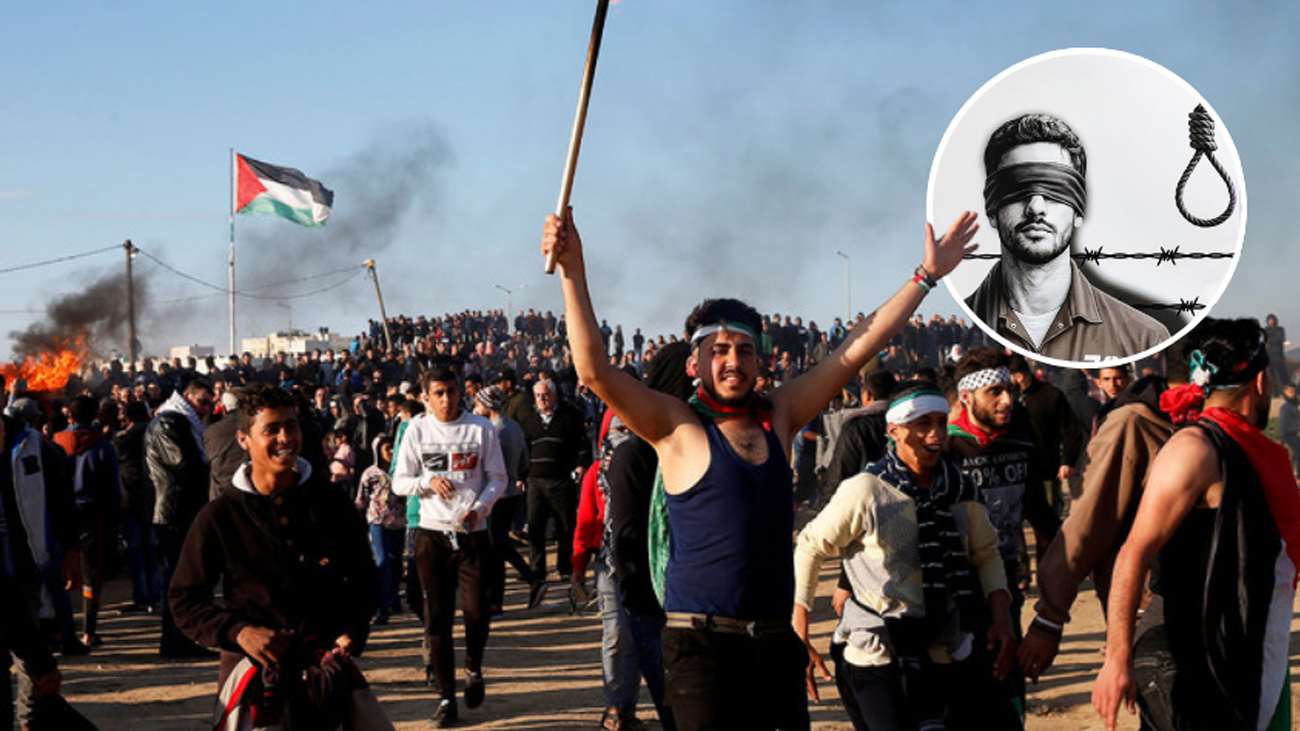
Palestinian shops, businesses, and public institutions across the occupied West Bank closed on Wednesday as part of a general strike against a new Israeli law allowing the execution of Palestinians convicted of deadly attacks.
The strike was observed in major cities, including Hebron, Ramallah, and Nablus, where many shops kept their shutters down, and markets remained largely empty.
The protest call was given by the Fatah party led by Palestinian Authority President Mahmud Abbas. Demonstrators also marched in several cities to express anger over the controversial legislation.
Also Read: Iranian president demands guarantee war will not restart
In Ramallah, the administrative center of the Palestinian Authority, large shopping areas and the main market were completely closed. Many students also stayed away from universities as educational institutions joined the strike.
People gathered on the streets to protest against the law, which is supported by Israel’s far-right National Security Minister, Itamar Ben Gvir.
“It’s a crazy law to be passed, it’s insane,” said Mohammed Gussein, a 24-year-old student at Al-Quds University, which was also closed during the strike.
He added that the law was “completely out of touch with humanity, and completely racist.”
Another protester, a psychologist from Ramallah who identified herself only as Riman, said nearly every Palestinian family has someone in prison.
“There isn’t a single person standing here who doesn’t have a brother, a husband, a son, or even a neighbor in prison. There is no Palestinian family without a prisoner,” she said.
She added that people feel anger, but also worry about weak international support. “The occupation is betting on the weakness of the street,” she said.
The new law was approved by Israel’s parliament earlier this week. Under the legislation, Palestinians in the West Bank who are convicted by military courts of deadly attacks classified as “terrorism” could face the death penalty as the default punishment.
Also Read: 18 dead as migrant boat sinks off Turkey’s Aegean coast
Since Palestinians in the West Bank are usually tried in Israeli military courts, critics say the law creates a separate and harsher legal system for them.
In Israeli civilian courts, the law allows either the death penalty or life imprisonment for those found guilty of killing with the intent to harm the state.
Although the law will not apply to past cases, many critics argue it highlights deep inequality in the justice system.
Meanwhile, images circulating on social media showed protesters burning tyres at the Qalandia checkpoint, one of the busiest crossings between the West Bank and Jerusalem.