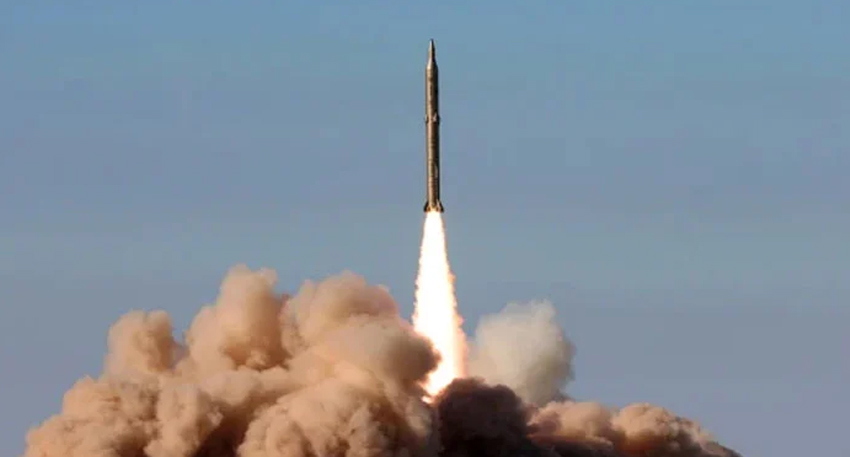
Iran has reportedly used its Sejjil ballistic missile for the first time during a recent attack on Israel, highlighting the growing capabilities of Iran’s missile program. The missile is considered one of Iran’s most advanced long-range weapons and is designed to strike targets across large parts of the Middle East, Europe, and Asia.
Defense analysts say the deployment of the Sejjil missile signals Iran’s increasing focus on developing domestically produced strategic weapons with longer ranges and higher speed.
What Is the Sejjil Missile?
The Sejjil missile is a two-stage, solid-fuel ballistic missile designed and developed entirely within Iran. Unlike liquid-fuel missiles, solid-fuel systems can be launched much faster because they require less preparation time.
According to a report published by The National Interest, the missile has:
- Payload capacity: Approximately 700 kilograms
- Range: Around 2,000 to 2,500 kilometers
- Type: Two-stage solid-fuel ballistic missile
Because of its long range, the missile could potentially reach targets across multiple regions if deployed strategically.
Also Read: North Korea fires 10 missiles amid US-South Korea drills
Potential Strike Range of the Sejjil Missile
If the estimated range is accurate, the Sejjil missile could theoretically reach several regions, including parts of:
- Egypt
- Sudan
- Ukraine
- Southern Russia
- Western China
- India
- Large areas of the Indian Ocean and Mediterranean Sea
This wide range places many strategic regions within potential striking distance.
Nuclear Capability Concerns
Defense experts warn that if the Sejjil missile were equipped with a nuclear warhead, it could significantly increase the missile’s destructive capability. Although Iran maintains that its nuclear program is for peaceful purposes, Western analysts continue to monitor the country’s missile development closely.
The missile’s high speed, mobility, and solid-fuel technology make it difficult to intercept once launched.
Development and Test History
Work on the Sejjil missile program reportedly began in the early 1990s as part of Iran’s broader missile development strategy.
According to analysis by Center for Strategic and International Studies (CSIS):
- The first test launch took place in 2008, reportedly covering about 800 kilometers.
- A second test was conducted in 2009 to evaluate improved navigation and guidance systems.
- Since then, multiple flight tests have been conducted to improve accuracy and performance.
During one of the later tests, the missile reportedly traveled approximately 1,900 kilometers over the Indian Ocean, demonstrating its long-range strike capability.
Strategic Importance of the Sejjil Missile
Military analysts say the Sejjil missile represents a major step forward in Iran’s strategic defense capabilities because it:
- Uses solid-fuel technology for faster launch readiness
- Has long-range strike capability
- Can carry a large payload
- Enhances Iran’s deterrence strategy
The missile is widely viewed as one of the key components of Iran’s expanding ballistic missile arsenal.