Several Gulf Arab countries reported missile attacks from Iran after Tehran promised to respond to military action by the United States and Israel. The strikes have brought open conflict to a region that usually presents itself as stable and secure.
According to state media in the United Arab Emirates, one person was killed in Abu Dhabi. Officials did not share further details about the victim or the exact location of the impact.
Other Gulf states also confirmed that missiles were launched toward their territories. Air defense systems were activated in different cities, and residents reported hearing loud explosions in the sky. Authorities in several countries quickly moved to heighten security and monitor the situation closely.
The latest escalation follows Tehran’s pledge to retaliate after recent strikes by the US and Israel. The developments have increased fears that the conflict could spread across more parts of the Middle East.
For years, many Gulf nations have enjoyed relative peace despite regional tensions. However, the recent missile attacks have shaken that sense of safety and raised concerns among citizens and expatriates alike.
Read more: Russia slams US-Israel attack on Iran, fears wider regional war
Kuwait, Qatar, the UAE, and Jordan, all of which have a U.S. military presence, said they had intercepted the Iranian missiles.
"All occupied territories and the criminal U.S. bases in the region have been struck by the powerful blows of Iranian missiles. This operation will continue relentlessly until the enemy is decisively defeated," Iran's Revolutionary Guards said.
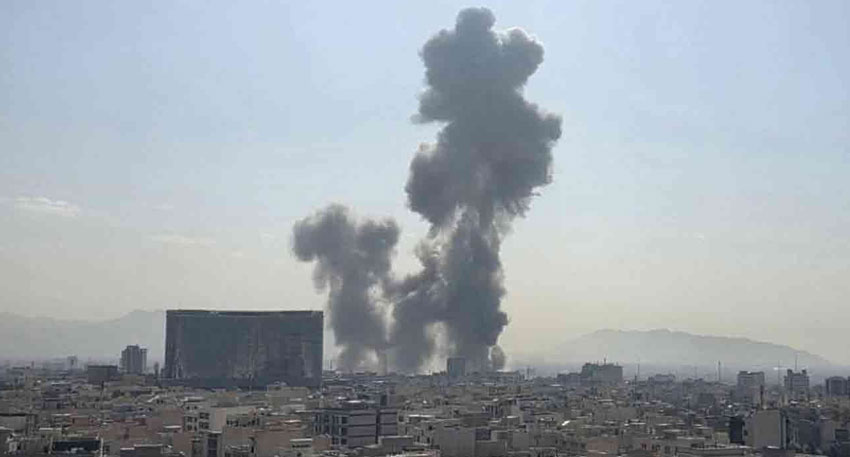
Bahrain confirmed an attack inside its territory and said a service center of the U.S. Fifth Fleet had been struck. Video from a Reuters witness showed a plume of grey smoke rising near the small island nation's coast as sirens wailed.
Loud booms were heard across Abu Dhabi, according to five witnesses including two Reuters correspondents. Some residents received a phone alert telling them to shelter in the closest secure building and stay away from windows because of missile threats.
One witness told Reuters she heard five booms in rapid succession that caused windows in a house near Abu Dhabi's Corniche to vibrate. Other witnesses in the Al Dhafra and Bateen areas heard loud booms as well.
Fighter jets could be seen flying around the Yas Island area of Abu Dhabi on Saturday afternoon.
In Qatar, the military said in a statement that it had intercepted incoming Iranian missiles before they reached Qatari territory after "joint coordination". Several successive waves of blasts were heard in the Qatari capital Doha.
After the U.S. Embassy issued a warning to take shelter in Doha, many residents carried on their usual activities. Shoppers were in supermarkets, beachgoers headed to the seaside and a yellow double-decker tour bus filled with tourists drove through the city's West Bay district.
Later, when the government pushed a shelter-in-place warning to mobile phones, fewer people were seen out in the streets and traffic thinned.
The Kuwaiti army says it dealt with missiles in Kuwaiti airspace, while Jordan said it had downed two Iranian ballistic missiles.
Global airlines suspended flights across the Middle East, with flight maps showing the airspace over Iran virtually empty.
This incident shows how fast the crisis is spreading. Even countries that tried to stay away are now feeling the impact. If attacks continue, more lives could be at risk. Leaders may need urgent talks to prevent a wider war.