

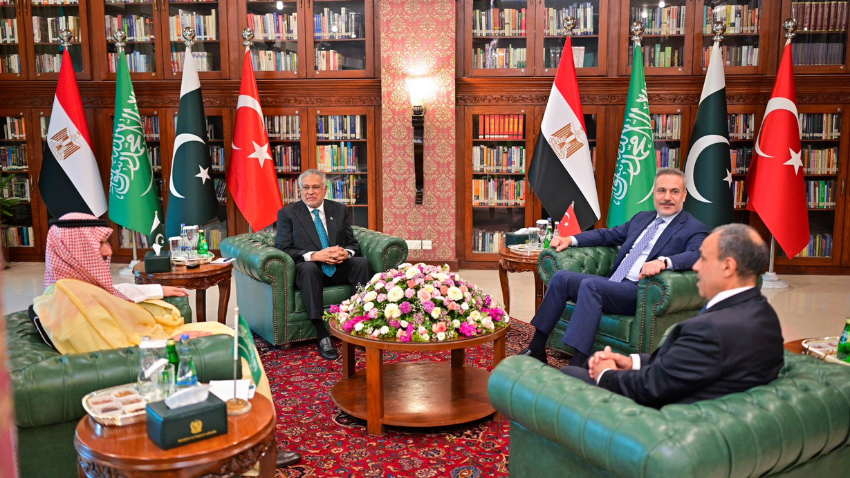
The talks were arranged by Deputy Prime Minister and Foreign Minister Ishaq Dar, who invited the leaders to Islamabad for urgent consultations on the regional situation.
Before the joint meeting, Dar held separate talks with all three foreign ministers. These meetings focused on strengthening relations and finding ways to reduce tensions through dialogue and diplomacy.
Egypt’s Foreign Minister Dr. Badr Abdelatty, Turkiye’s Foreign Minister Hakan Fidan, and Saudi Arabia’s Foreign Minister Faisal bin Farhan al Saud all arrived in Islamabad and were warmly received by Pakistani officials.
The Consultations among the Foreign Ministers of Pakistan, Saudi Arabia, Türkiye, and Egypt have commenced in Islamabad on 29 March 2026.
— Ministry of Foreign Affairs - Pakistan (@ForeignOfficePk) March 29, 2026
Convened at the invitation of Deputy Prime Minister / Foreign Minister Senator Mohammad Ishaq Dar @MIshaqDar50, the Foreign Ministers during… pic.twitter.com/5capTCXUNO
During the discussions, all sides agreed on the importance of peaceful solutions. They stressed the need for dialogue, cooperation, and efforts to avoid further escalation in the region.
Also Read: Iran allows 20 more Pakistani ships through Strait of Hormuz
Officials said the two-day meeting will cover key issues such as regional security, the Middle East crisis, and joint strategies to bring stability. A combined plan for peace is expected after these talks.
Pakistan is playing an increasingly important role as a mediator between the United States and Iran. The country is helping pass messages between both sides and has even offered to host formal peace talks.
Prime Minister Shehbaz Sharif recently suggested Pakistan as a venue for US-Iran negotiations, a move that gained attention internationally.
Diplomatic sources say Turkiye and Egypt are also supporting efforts to reduce tensions, while Pakistan continues to engage with global leaders to promote peace.
These talks are seen as a major step toward calming the situation and preventing further conflict in the region.


