

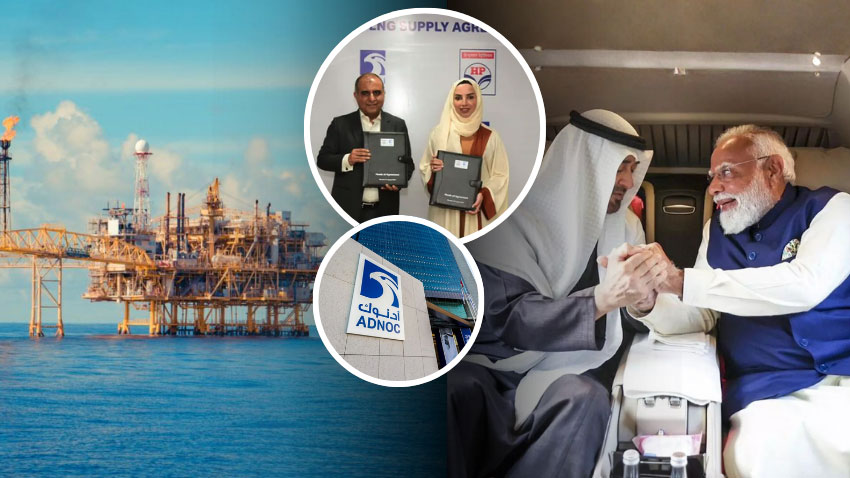
India signed a major energy agreement with the United Arab Emirates (UAE), making the Gulf nation its top customer for liquefied natural gas. The deal was announced after talks between the leaders of both countries.
The agreement was signed during a brief two-hour visit to India by UAE President Sheikh Mohammed bin Zayed Al Nahyan. He met Prime Minister Narendra Modi to discuss closer cooperation.
Both leaders agreed to double bilateral trade to $200 billion within six years. They also decided to move towards a strategic defense partnership.
Also Read: Any attack on Supreme Leader equals full-scale war: Iranian President
Under the deal, Abu Dhabi’s state-owned Abu Dhabi National Oil Company (ADNOC) Gas will supply 0.5 million metric tons of LNG every year to Hindustan Petroleum Corp. The supply will continue for 10 years.
ADNOC Gas said this agreement takes the total value of its contracts with India to more than $20billion. The company described India as its largest and most important LNG customer.
“India is now the UAE’s largest customer and a very important part of ADNOC Gas’ LNG strategy,” the company said.
The UAE is India’s third-largest trading partner. Sheikh Mohammed was joined by senior officials, including the UAE’s defence and foreign ministers.
Both sides also signed a letter of intent to work towards a strategic defence partnership, India’s Foreign Secretary Vikram Misri told reporters.
Also Read: Trump invites PM Shehbaz to Gaza Peace Board
The move comes at a time when regional defence alignments are changing. Pakistan recently signed defence agreements with Saudi Arabia and is preparing a broader pact with Turkiye.
Despite this, Misri clarified that India’s defence cooperation with the UAE does not mean involvement in regional conflicts.
“Our involvement on the defence and security front with a country from the region does not necessarily lead to the conclusion that we will get involved in particular ways in the conflicts of the region,” he said.


