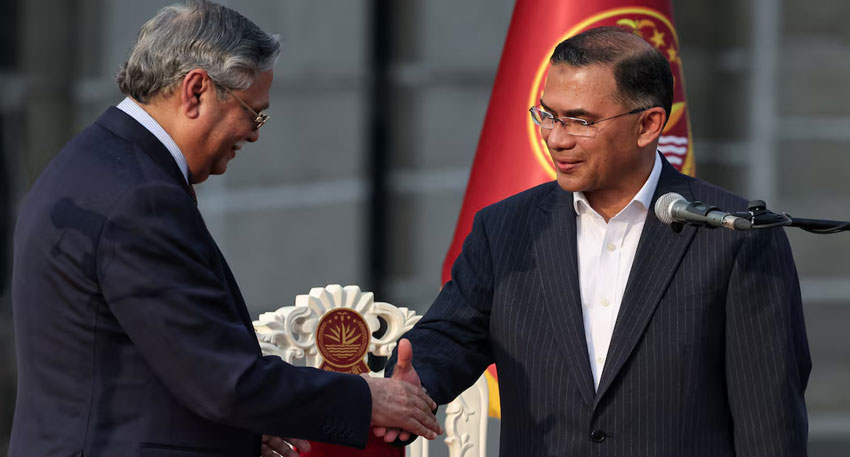
Tarique Rahman, 60, officially took oath as prime minister after his party, the Bangladesh Nationalist Party (BNP), secured a sweeping victory in parliamentary elections. His appointment comes after a long period of political instability.
Rahman is the son of former prime minister Khaleda Zia and late president Ziaur Rahman. His rise to power marks the return of a powerful political family to the country’s leadership.
His government now faces serious and immediate challenges. The country is still recovering from unrest triggered by a Gen Z-led uprising that forced former prime minister Sheikh Hasina to step down in 2024.
One of Rahman’s biggest tasks is to restore political stability. Investors have become cautious due to uncertainty, and economic activity has slowed down in recent months.
The garment industry, which is the backbone of Bangladesh’s economy, also needs urgent attention. This sector provides millions of jobs and plays a key role in exports, but instability has affected production and confidence.
Many citizens and business leaders are now watching closely to see whether Rahman can bring stability, improve the economy, and rebuild trust in the government.
This is a major political comeback for Tarique Rahman. He must quickly stabilize the country to gain trust. Economic recovery will decide his political future. Public expectations are very high right now.
An interim administration led by Nobel laureate Muhammad Yunus ran the country through the transitional period leading up to the election.
Read more: Muhammad Yunus resigns as Bangladesh welcomes new leadership
Breaking with tradition, the open-air swearing‑in ceremony was held at the South Plaza of the national parliament building, instead of the Bangabhaban, the president’s official residence.
President Mohammed Shahabuddin officiated as Rahman and his 49-member council of ministers took oaths in the presence of senior political figures, diplomats, civil and military officials, and representatives from countries including China, India and Pakistan.
The new government includes both senior and junior ministers - a mix of experienced BNP leaders and fresh faces, reflecting an effort to balance political experience with technocratic expertise as the government focuses on economic recovery, law and order, and governance reforms.
Former Commerce Minister Amir Khasru Mahmud Chowdhury was named finance minister, and Khalilur Rahman, who was national security adviser in the interim government, was made foreign minister.
Rahman’s BNP secured a commanding two‑thirds majority, returning to power after nearly two decades. The Islamist party Jamaat‑e‑Islami, contesting its first election since a 2013 ban was lifted following Hasina’s ouster, won a record 68 seats.
Hasina's Awami League party was banned from contesting after its registration was revoked by the Election Commission.
Jamaat and its allies — including the National Citizen Party (NCP), led by youth activists who played a prominent role in the movement that toppled Hasina — will form the opposition.
Jamaat and the NCP did not attend the ceremony in protest after Rahman's party rejected the interim government’s request for its lawmakers to take an additional oath under the proposed 'Constitution Reform Council'. The council intends to amend the constitution following the referendum held alongside the national election.
While K-pop might be booming globally, another form of South Korean entertainment is fighting for survival.
Rahman’s elevation caps a long and turbulent political journey. He returned to Bangladesh last year after 17 years of self‑imposed exile in London, arriving shortly before his mother’s death.
Rivals have long criticised his political record, pointing to corruption allegations he denies, but his return energised party supporters and reshaped the BNP’s campaign.
In his first remarks after the election, Rahman urged calm and restraint, saying: “Peace, law and order must be maintained at any cost ... We will not tolerate any kind of chaos.”