

2 Nepal tunnel workers rescued alive after 9 days underground
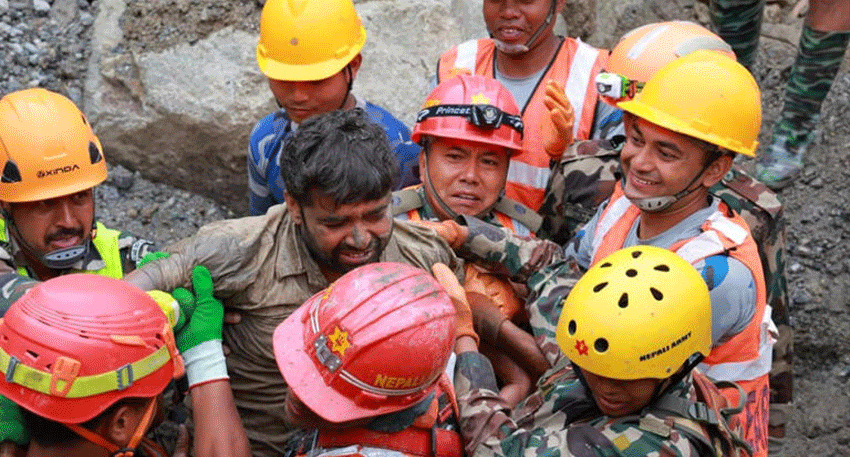
The rescue showed a rare moment of relief after horrific floods swept across Nepal, killing more than 1,250 people and leaving thousands missing.
The two workers were pulled from the Trishuli 3A hydropower tunnel on Friday after rescuers cleared a path through thick mud blocking the underground passage.
Workers identified after miraculous rescue
Nepal’s Home Minister Sudan Gurung identified the rescued men as Sanjay Shah, 30, a mechanical foreman, and Kabir Maharjan, 45, a mechanical supervisor.
Their rescue brought relief for their families, who had been waiting for news since the deadly flooding hit the region.
“I am so happy, my heart is lighter,” Amir Maharjan, the brother of Kabir Maharjan, told the media after learning that his brother had survived.
The two men were among hundreds of hydropower workers who had been reported missing after a huge wall of mud swept through the area on August 26.
Energy Minister Biraj Bhakta Shrestha confirmed that one worker had first been brought out of the Trishuli 3A tunnel, followed shortly afterwards by the second.
“We have just received news that another person has also been rescued,” Gurung said in a statement.
Officials had earlier believed that more than 100 workers could still be alive inside several hydropower tunnels. Search operations therefore continued at Trishuli 3A and other locations.
Slight response raised hopes underground
Australian rescue expert Arnold Dix, who has experience with major tunnel emergencies, said teams believed they had heard a response from people trapped inside.
Rescuers reportedly called into the tunnel and said, “Don’t worry, we are rescuing you.”
Dix told AFP that the team believed it heard a faint response saying, “hunchha”, a Nepali word used to mean yes or OK.
“They believe they received a faint response from inside saying, ‘hunchha’, yes or OK,” Dix said.
The rescue expert, who is president of the International Tunnelling and Underground Space Association, had been advising the operation remotely.
He was also travelling to Nepal to support rescue teams working at the disaster site.
“Right now, I’m ‘glass three-quarters full’, After a week of 24/7 heartache, we might, just, be back in miracle country,” Dix said.
His comments came as rescue workers were racing against time to reach anyone who might still be alive beneath the debris.
Also Read: Thailand’s Jurassic Park reveals millions-of-years-old dinosaur fossils
Rescuers cleared 60 metres of debris
According to Dix, rescue teams had already dug through around 50 to 60 metres of debris blocking the tunnel.
The operation was difficult because the tunnel had been heavily affected by mud, rocks and other material carried by the floodwaters.
Teams continued working around the clock as hopes of reaching survivors grew stronger following the reported response from inside.
Less than an hour after Dix spoke about the possible breakthrough, rescuers succeeded in bringing the two workers out alive.
Their rescue provided an important moment of hope following one of Nepal’s deadliest recent disasters.
Disaster leaves thousands missing
The tunnel rescue took place against the backdrop of a much wider humanitarian crisis across the region.
Nepalese authorities have recovered more than 1,250 bodies, while more than 5,000 people remain missing following the massive wave of mud, water and debris.
The disaster was triggered by a rock and ice avalanche near the China-Nepal border, sending a powerful flow through mountain communities and infrastructure.
Hydropower facilities were among the areas badly affected, leaving workers trapped and cutting off access to several sites.
Rescue teams have been searching damaged tunnels and other structures while dealing with difficult mountain conditions.
The recovery effort has also required specialist equipment and expertise because large quantities of debris have blocked access to affected areas.


