

SpaceX rocket stage crashes into the Moon, leaves deep crater
How the impact was confirmed
The 8,800-pound stage, roughly 45 feet long and 12 feet wide, struck the moon at approximately 5,400 miles per hour, releasing energy equivalent to nearly three tons of TNT. Scientists were unable to see the impact directly, since it struck the sunlit side of the moon where flashes are effectively undetectable, even with powerful telescopes.
Instead, researchers confirmed the collision indirectly. Planetary scientist Carl Schmidt of Boston University said a plume of sodium and lithium gas was picked up by the Very Large Telescope in Chile, while a separate observer in Sudbury, Massachusetts detected a matching sodium emission at roughly the same time.
Why the rocket hit the Moon
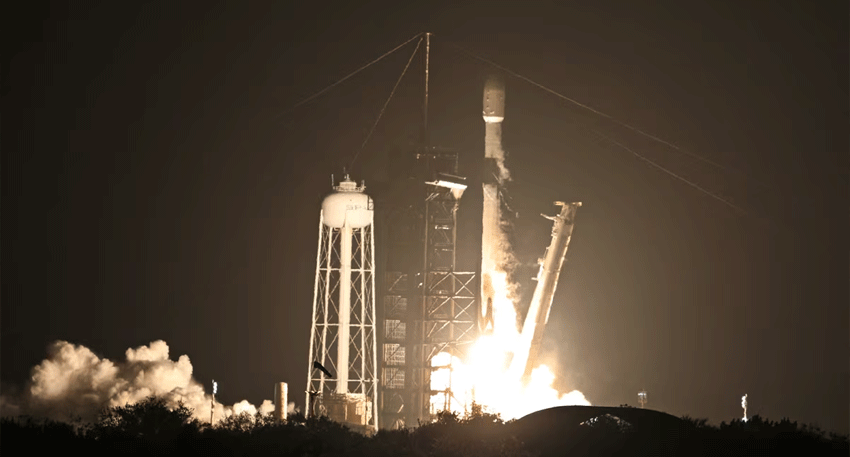
The stage had originally launched two lunar landers into space in January last year, before separating from its payload once the spacecraft continued on their own paths. One of those landers, Firefly's Blue Ghost-1, successfully touched down on the moon, while Japan's ispace Hakuto-R lander crash-landed on the surface during its own attempt.
The spent upper stage, however, kept drifting through space for well over a year afterward. SpaceX's Julianna Scheiman, the company's director of NASA Science and Dragon Programs, said the stage had been disposed of following standard procedures, but a combination of solar activity and gravitational forces gradually pulled it onto a collision course with the moon.
NASA's Center for Near Earth Object Studies later confirmed the object had a 100 percent chance of impact, based on trajectory data independently identified by astronomers using publicly available tracking information.
Scale of the impact and expected crater
Researchers estimate the resulting crater could measure up to 100 feet wide and 16 feet deep, based on the object's mass and the speed at which it struck the surface. Confirmation photos are expected from NASA's Lunar Reconnaissance Orbiter, a small satellite that regularly circles the moon, though officials cautioned it could take one to two weeks before before-and-after images become available.
A South Korean lunar satellite has already captured preliminary images believed to show the fresh impact site, according to separate reporting following the collision. NASA said the event, while attention-grabbing, is relatively modest in scale compared to the moon's constant natural bombardment.

Also Read:Galaxy Z leak: Is Samsung rollable phone a big smartphone innovation?
Researchers see the crash as a rare opportunity to study how debris plumes behave and what lies beneath the lunar surface at the impact site. Schmidt said he specifically hopes the resulting data could help reveal how much water ice may be hidden underground in that region of the moon.
NASA noted that a meteoroid carrying similar energy to the rocket stage strikes the moon roughly every six days, meaning the lunar surface constantly absorbs comparable natural impacts. Even so, artificial impacts of this scale remain uncommon enough to offer scientists a useful, trackable case study, unlike unpredictable natural strikes.
A rare but not unprecedented event
Human-made objects have struck the moon only a handful of times in history. The first came in 1959, when the Soviet Union deliberately crashed a spacecraft into the lunar surface, followed by discarded hardware from NASA's Apollo missions between 1969 and 1972.
A Japanese probe struck the moon in 1993, and a European Space Agency satellite did the same in 2006. In 2009, NASA intentionally crashed a rocket stage into a permanently shadowed crater near the lunar south pole specifically to search for water ice, a mission that ultimately confirmed the presence of ice in that region.
SpaceX said in a statement that it works to dispose of spent rocket hardware as responsibly as possible, adding that impacts like this remain rare but can occur with objects left in similar orbits over time. The company said it coordinated with NASA on the appropriate disposal approach for the stage before this outcome occurred.


