

NASA’s Voyager 1 probe crosses one light-day from Earth after 49 years
The spacecraft is now roughly 26 billion kilometres, or 16 billion miles, away from our home planet. That immense gap equals the exact distance a beam of light travels through space in 24 hours.
The Vastness of Deep Space
NASA scientist Tiffany Kataria noted that this milestone shows just how big the universe truly is. She explained that the historic achievement is “the best illustration of just how vast space is”.
Kataria shared with AFP that humanity often dreams about visiting distant worlds beyond our Sun. She added, “So much of what we dream about is traveling to other stellar systems.”
A Nearly Fifty-Year Journey
Even at blistering speeds, the spacecraft needed almost half a century to cover this cosmic stretch. Kataria remarked, “And it took Voyager 1 nearly 50 years to get to just the edge of our own solar system, let alone to only a light-day.”
She also highlighted that nearby exoplanet systems remain at least several light-years away from us. Launched back in 1977, Voyager 1 and its twin Voyager 2 are the only probes exploring interstellar space beyond our solar system.
Messages Across the Void
Because the probe is so far away, radio signals from Earth take a full day to reach it. Ground teams must then wait another 24 hours just to receive a simple reply back.
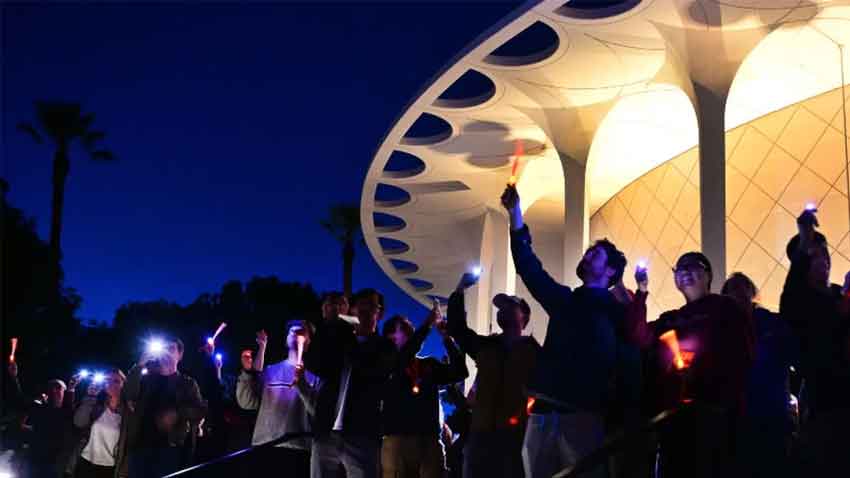
Both spacecraft carry 30-centimetre, gold-plated copper disks called “Golden Records” to tell Earth’s story to potential alien life. To celebrate the moment, people gathered at Caltech in Pasadena on November 17, 2026, to shine lights into the sky.
Science Beyond the Planets
NASA has turned off older equipment like the cameras to save the probe’s remaining power. However, Voyager 1 still tracks invisible forces such as magnetic fields in deep space.
This vital data helps experts examine “the gas, the dust and other material that exists between stars, between our Sun and other stars”. Before leaving our planetary neighborhood, both probes studied Jupiter, Saturn, Uranus, and Neptune, revealing Jupiter’s hidden rings and “really extreme vortices and weather that take place in the atmosphere”.
Voyager 1 reaching one light-day is a quiet triumph of old-school engineering. It shows that simple, sturdy machines built decades ago can outlast almost every modern gadget we own. At the same time, this record humbles us because a fifty-year trip is still just a tiny baby step compared to the stars. Reaching another solar system will clearly require brand-new ways to travel through space.
Also read: Yango becomes Pakistan’s first ride service to offer card payments


