

Jinnah-1: Pakistan names its first lunar rover for Moon mission
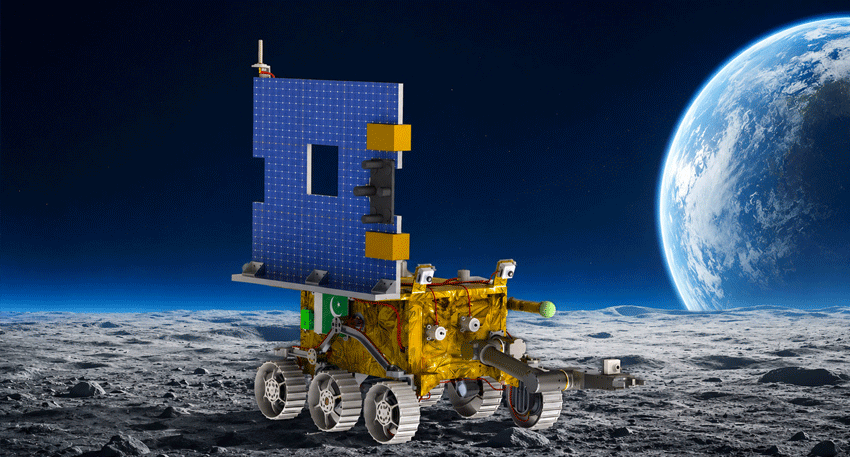
The Space and Upper Atmosphere Research Commission (SUPARCO) selected the name Jinnah-1 from entries submitted by people across Pakistan.
The name pays tribute to Quaid-e-Azam Muhammad Ali Jinnah and is being presented as a symbol of Pakistan’s growing ambitions in space exploration.
Seven participants had suggested the name Jinnah-1. The winner was selected through a draw, with 17-year-old Tayyab Karim from Bahawalnagar declared the winner.
The naming contest allowed members of the public to become part of Pakistan’s first lunar exploration project.
Jinnah-1 to explore the Moon
Pakistan’s lunar rover is being developed for a mission to the Moon’s south pole in cooperation with China.
According to SUPARCO’s official programme information, the rover is planned to travel aboard China’s Chang’e-8 mission, currently scheduled for launch in 2028.
The rover will be used to conduct scientific research on the lunar surface. Its work is expected to include studying lunar soil, mapping the surface and testing technologies relevant to future lunar exploration.
China’s space agency has also said the SUPARCO-developed rover will contribute to terrain mapping and analysis of lunar surface material.
The Moon’s south pole has become a major focus of international space programmes because scientists are particularly interested in its unusual environment and possible water-ice resources.
A major step for Pakistan’s space programme
The mission represents an important step for Pakistan, which is expanding its involvement in space science beyond satellite missions.
SUPARCO and the China National Space Administration have established cooperation that will allow Pakistan’s indigenous rover to participate in the Chang’e-8 mission.
SUPARCO has said Pakistani scientists and engineers have been involved in designing, manufacturing, assembling, integrating and testing the rover. Once deployed on the Moon, Pakistani scientists are expected to control and operate it from Earth.
The rover is also part of wider international cooperation linked to China’s International Lunar Research Station initiative.
Pakistan’s participation could provide local scientists and engineers with practical experience in lunar science, robotics and deep-space mission operations.
What will the rover study?
The lunar rover will carry scientific equipment designed to collect information from the Moon’s surface.
Its planned activities include studying lunar soil composition and examining the potential use of lunar resources. It will also help scientists map areas of the lunar surface for future exploration.
The mission is expected to contribute to research into radiation levels and plasma conditions on the Moon.
These studies could help scientists understand the environment future spacecraft and astronauts may face during longer lunar missions.
The rover will also test technologies that could support future operations on the Moon.
Why the name Jinnah-1 matters
The name Jinnah-1 links Pakistan’s space ambitions with the legacy of Muhammad Ali Jinnah.
SUPARCO Chairman said the name represents a tribute to the founder of Pakistan and reflects the country’s determination to explore new frontiers.
The nationwide naming contest also helped connect the public with a major scientific project.
With thousands of suggestions submitted, the competition attracted considerable interest in Pakistan’s first lunar rover.
The selection of a young winner from Bahawalnagar further highlights the role that students and young people can play in the country’s growing space sector.
Also Read:Apple Music is finally set to officially launch in Pakistan
Pakistan and China deepen space cooperation
The lunar rover mission is part of broader cooperation between Pakistan and China in space exploration.
Pakistan has already worked with China on satellite projects and other space-related initiatives. The lunar mission takes this cooperation further by giving Pakistani scientists a role in an international exploration programme.
The project also reflects Pakistan’s stated interest in developing indigenous space capabilities.
The federal development programme for 2025-26 includes Rs400 million for the development of the Pakistan Lunar Exploration Rover for the Chang’e-8 mission.
SUPARCO’s official programme currently lists the lunar rover launch for 2028, rather than 2029.


