

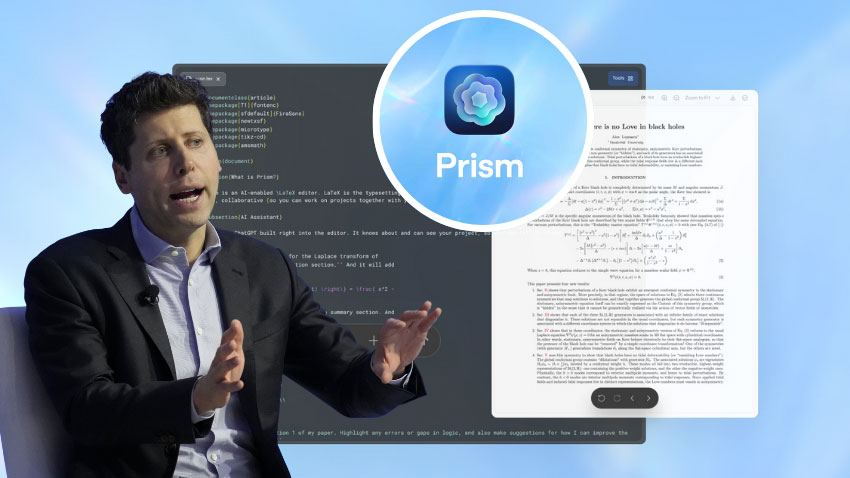
OpenAI said Prism aims to do for scientists what coding agents have already done for software developers. The goal is to reduce the time spent on repetitive research tasks and help scientists focus more on ideas and discoveries.
Prism is built on Crixet, a cloud-based LaTeX platform that OpenAI has acquired. LaTeX is widely used by scientists to format research papers, but it can be slow and complex, especially for diagrams and technical layouts.
Instead of switching between many tools, Prism brings everything into one place. It offers advanced LaTeX editing along with an AI assistant powered by GPT-5.2 Thinking, replacing Crixet’s earlier Chirp agent.
Also Read: China weaves computers into clothes with breakthrough ‘fiber chip’
During a live demonstration, OpenAI showed how Prism can search for relevant scientific studies and add them directly into a paper. The system also created a full bibliography automatically.
Kevin Weil, OpenAI’s vice president of science, said AI does not remove a researcher’s responsibility. “None of this exempts the scientist from the responsibility of confirming the accuracy of their references, but it certainly has the potential to accelerate the process.”
He added that OpenAI is aware of concerns about trust and quality in research. “Our view is that the right response is not to keep AI at arm’s length… It’s to integrate it directly into scientific workflows in ways that preserve accountability.”
Also Read: PTA revises tax values for used iPhones
Prism can also support teaching. In the same demo, the tool created a graduate-level lesson plan on general relativity and generated problem sets for students, showing its potential use in classrooms.
OpenAI said Prism is now available to all users with a personal ChatGPT account. It allows unlimited projects and collaborators. The company plans to expand access to Business, Team, Enterprise, and Education users soon, and Crixet will no longer be offered separately.


