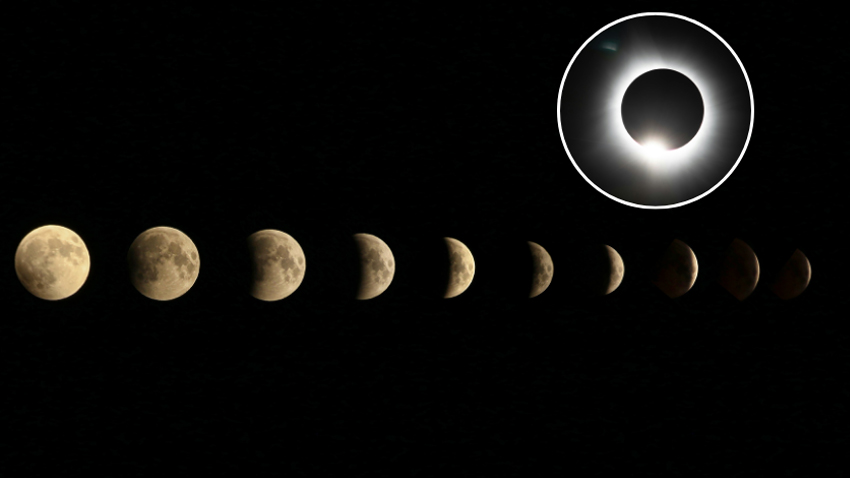
The celestial event will be visible in many parts of the world, including East Europe, Asia, Australia, North and South America, and parts of the Pacific, Atlantic, and Indian Oceans.
In Pakistan, however, the eclipse will be partially visible at the time of moonrise. This means people will not see the entire process, but they can still witness an important part of the event.
According to the official timeline in Pakistan Standard Time, the penumbral eclipse will begin at 13:44 PST. The partial eclipse will start at 14:50 PST.
The total eclipse phase will begin at 16:05 PST and reach its peak at 16:34 PST. It will end at 17:03 PST. The partial phase will conclude at 18:17 PST, while the penumbral phase will finally end at 19:23 PST.
Also Read: When is Eidul Fitr in Pakistan? PMD reveals possible date
Experts encourage skywatchers to look toward the horizon at moonrise for the best view. Clear skies will improve the chances of seeing the Moon’s changing colors.
A lunar eclipse happens when the Earth moves between the Sun and the Moon, blocking sunlight and casting a shadow on the Moon. This can only occur during a full moon when all three bodies align in a straight line.
There are three types of lunar eclipses: total, partial, and penumbral. During a total eclipse, the Moon passes completely through the darkest part of Earth’s shadow and often turns red, a phenomenon known as a “blood moon”.
Unlike solar eclipses, lunar eclipses are safe to watch with the naked eye. No special equipment is required, making it an exciting event for families, students, and astronomy lovers.