

Lahore tops world’s most polluted major cities amid dangerous smog levels
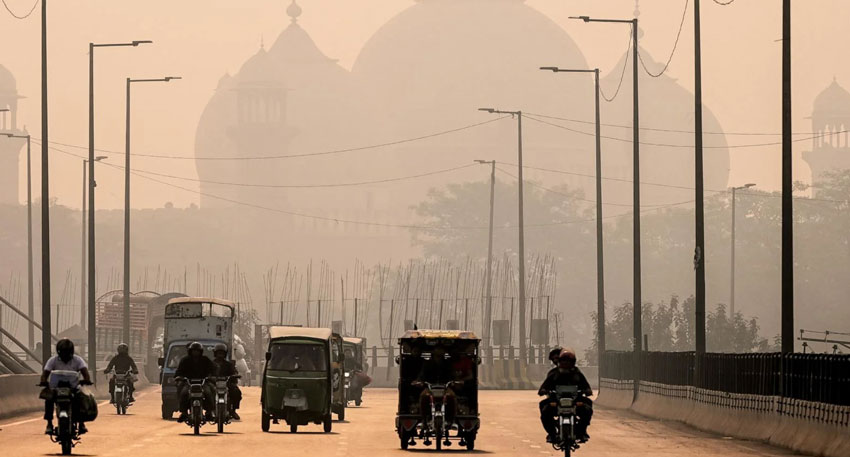
Lahore tops global pollution ranking
Lahore was ranked the world’s most polluted major city on Thursday morning, according to IQAir’s live ranking for October 29. Cairo followed with an Air Quality Index (AQI) of 274, while Delhi recorded 220 and Karachi ranked eighth with 165.
The Punjab government’s monitoring dashboard also showed unhealthy air across several cities, although its readings differed from IQAir’s figures. Kasur recorded an AQI of 348, followed by Lahore at 324, Faisalabad at 290, Kot Addu at 269 and Dera Ghazi Khan at 267.
Nankana Sahib recorded an AQI of 261, while Hafizabad stood at 250 and Sahiwal at 210. Sheikhupura, Jhang and Rajanpur recorded 205, 203 and 201, respectively.
Multan and Gujranwala both reported an AQI of 194, while Bhakkar recorded 186 and Vehari 181. Later, at 1pm, IQAir placed Lahore fifth globally with an AQI of 183, while the provincial dashboard showed Khanewal as Punjab’s most polluted city at 212 and Lahore at 173.
Punjab steps up action against polluters
The Punjab government has increased enforcement against vehicles releasing excessive smoke, brick kilns, factories, plastic burning and construction dust. The Punjab Safe Cities Authority (PSCA) said it was using artificial intelligence-powered cameras to identify violations linked to smog.
The authority urged motorists to avoid using vehicles that release excessive smoke and asked people not to burn waste. Residents can report such violations by calling police emergency number 15.
The Environment Protection Agency (EPA) also carried out a month-long crackdown from September 28 to October 27. During this period, it demolished 197 non-compliant brick kilns, sealed 163 units and registered 162 first information reports (FIRs).
EPA reports inspections, fines and closures
EPA Director General Abdullah Nayyar Sheikh said the department was following a data-based, zero-tolerance policy to protect public health. He said inspection teams were using field visits, surveillance and special day-and-night operations to identify violations.
Official figures show that EPA teams inspected brick kilns 11,580 times, issued 314 notices and imposed fines worth Rs40.7 million. The department also inspected 6,650 industrial sites, demolished 22 non-compliant units, issued 333 notices, sealed 191 premises and registered 15 FIRs, collecting Rs28 million in fines.
Action against plastic burning included 6,064 inspections and 678 notices, while 152 premises were sealed and 45,100 kilogrammes of plastic were confiscated. The department also imposed around Rs2 million in fines related to these violations.
In a separate drive, officials inspected 4,204 industrial sites to check the installation of suction hoods, which help control emissions. They reported that 1,863 units had installed the equipment, while 1,388 notices were issued, 333 sites were sealed and Rs2.0045 million was collected in penalties.
Measures target dust and crop burning
The EPA also took action against construction dust by visiting 397 union councils, issuing 181 notices and sealing 20 locations. Fines totalling Rs25,000 were imposed, while mist sprinklers were installed at 49 sites to reduce dust from construction work and exposed surfaces.
Officials also inspected 56 activities linked to water pollution, issued 29 notices and sealed two units. These measures formed part of the department’s wider effort to address different sources of environmental pollution.
To control smoke from crop-residue burning, the Punjab government deployed 67 Quick Response Units in major agricultural areas. The teams use satellite fire detection, local information and field monitoring to locate fires, extinguish them and take action against those responsible.
The EPA has also deployed anti-smog guns at selected locations in Lahore, including busy roads, industrial areas and construction sites. Sheikh said their placement depended on local conditions, AQI readings, particulate matter levels and wind patterns.
The equipment releases fine water droplets that can bind with suspended dust particles and help bring some of them to the ground. However, the department stressed that these devices support wider anti-smog efforts and cannot replace action to control pollution at its source.
The pollution readings show that Lahore and several other Punjab cities are facing serious air-quality problems as smog season approaches. Differences between monitoring platforms also show why readings should be considered alongside their locations and reporting times.
The government has increased inspections, penalties and other enforcement measures, but lasting improvement will depend on reducing emissions from vehicles, factories, brick kilns, crop burning and construction activities. Anti-smog equipment may help in selected areas, but controlling pollution at its source remains essential.
Also read: Pakistan and China sign green channel deal to speed up border trade


