The National Database and Registration Authority (NADRA) has introduced a major CNIC change after the Federal Government formally notified sweeping amendments to the National Identity Card Rules, 2002 and the Pakistan Origin Card Rules, 2002.
Issued through S.R.O. 330(I)/2026 and S.R.O. 331(I)/2026 under Section 44 of the NADRA Ordinance, 2000, the amendments were published in the Gazette of Pakistan on February 24, 2026. The reforms aim to establish a fully integrated digital identity ecosystem in Pakistan.
QR Code CNIC: End of Dual Card System
A landmark feature of the reform is the statutory introduction of the QR code CNIC system. The Quick Response (QR) code has now been legally defined as a secure, machine-readable, two-dimensional barcode capable of storing encoded identity data for instant verification when scanned.
Under the revised rules, NADRA is authorized to use a “QR code or any other technological feature” instead of the current microchip system. This gives flexibility to adopt evolving verification technologies without repeated legal amendments.
The move also paves the way for a uniform national identity card, replacing the existing dual structure of chip-based Smart CNIC and non-chip CNIC. All citizens will now be issued standardized cards equipped with advanced QR-enabled verification.
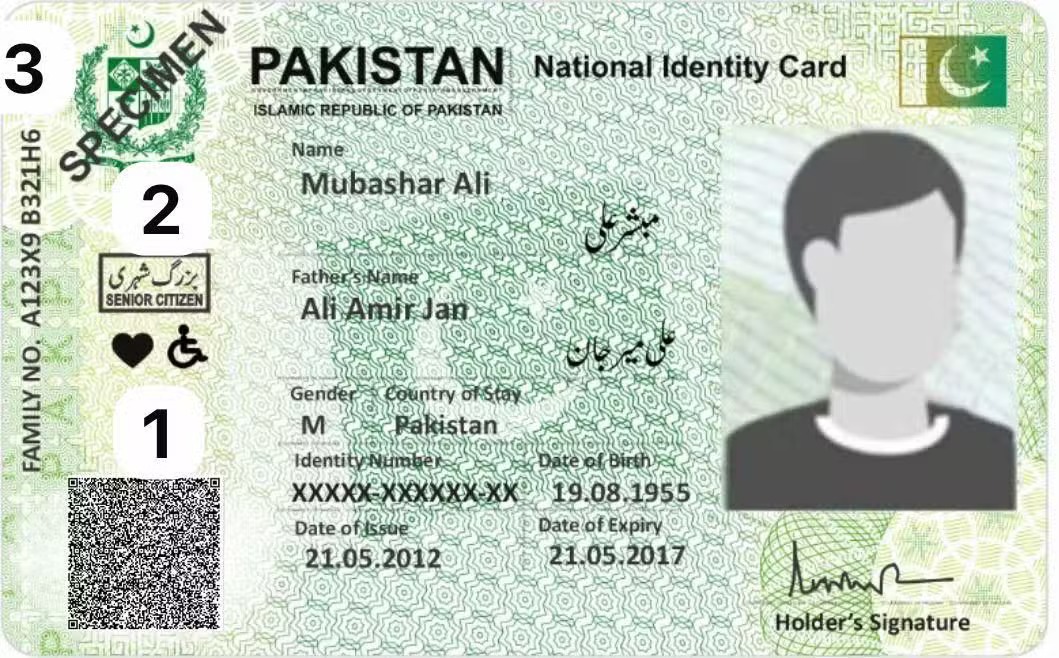
[(1) QR Code, (2) Senior Citizen and Other Logos, (3) Family Number]
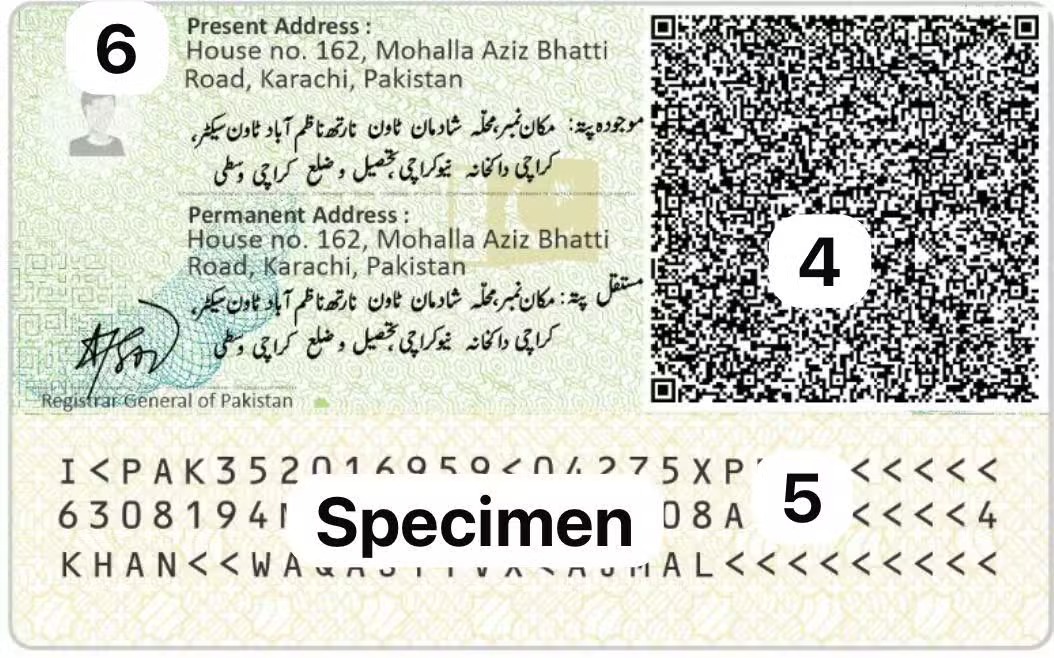
[(4) QR Code, (5) Additional Information for NICOP and POC, (6) Bilingual Data]
Also Read: NADRA Announces New CNIC Policy for Citizens Without Birth Certificates
Stronger Digital ID and National Data Exchange Layer Integration
The QR-based verification system strengthens Pakistan’s Digital ID infrastructure by enabling seamless interoperability through the National Data Exchange Layer.
QR-enabled credentials will allow:
- Instant front-end verification at service counters
- Secure back-end authentication through trusted data exchange
- Faster processing across government departments and regulated sectors
The new framework is expected to reduce fraud, curb impersonation, minimize manual errors, and enhance transparency in identity verification.
Immediate Suspension of CNIC Services
The amendments also tighten enforcement mechanisms. If a CNIC is suspended, all linked verification, authentication, and related services will be suspended immediately.
This closes a major loophole by ensuring that suspended cards cannot be used through digital verification channels or institutional authentication systems.
Expanded Biometric Recognition
The revised rules explicitly recognize fingerprints and iris scans, strengthening Pakistan’s multi-modal biometric authentication system. This modern biometric expansion enhances identity assurance and security standards nationwide.
Lifetime CNIC for Senior Citizens
A significant citizen-friendly reform includes lifetime validity CNICs for senior citizens aged 60 and above. These cards will carry a distinct senior citizen logo and eliminate the need for renewal, reducing burden and improving facilitation for elderly Pakistanis.
Special Identification for AJK Residents
The amendments introduce standardized identification for residents of Azad Jammu and Kashmir (AJK). CNICs will now include an inscription stating “Resident of Azad Jammu and Kashmir,” ensuring uniform geographic identification.
Also Read: NADRA imposes new rules on CNIC date of birth changes
Updated CNIC Formats Across Categories
NADRA has also updated specimen formats for multiple document categories, including:
- Resident citizens
- Overseas Pakistanis
- Child Registration Certificates
- Persons with disabilities
- Organ donors
- Combined identity categories
- AJK residents
All updated formats incorporate QR codes and enhanced security layouts, standardizing Pakistan’s modern identity document architecture.
A Major Step Toward Digital Governance
Overall, the NADRA CNIC amendments strengthen Pakistan’s legal and technological identity framework. By embedding QR-based verification, expanding biometric scope, enforcing strict suspension rules, and introducing lifetime cards for seniors, the government has taken a decisive step toward integrated digital governance.
The reforms also reinforce readiness for structured interoperability through the National Data Exchange Layer and a broader Digital ID ecosystem.