

From School Nutrition to Circularity
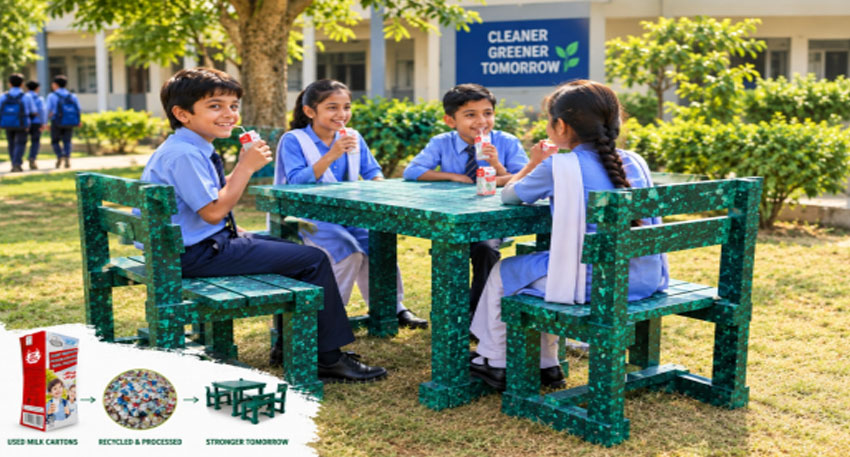
For children who may not have regular access to nutritious foods, a school milk programme can make that nutrition part of their daily lives.
That is the thinking behind World School Milk Day, launched by the Food and Agriculture Organization in 2000 to highlight the role of school milk programmes in supporting child nutrition and education. But as these programmes expand, the conversation needs to move beyond what milk delivers to children and consider what happens after it has been consumed.
The packaging is an increasingly important part of that equation.
In Pakistan, the scale of school milk distribution makes this more than a theoretical consideration. Punjab’s School Meal Programme is delivering around 1.2 million milk packs every day across 11 districts, with approximately 70 million packs planned between September 2026 and May 2027. At this scale, ensuring that the packaging is collected and recycled can become an important part of making the programme more sustainable.
This is where the principles of a circular economy become relevant. Rather than allowing used packaging to enter the waste stream, an organised system can collect, recover and recycle these materials, giving them value beyond their original purpose.
There are already examples of this approach within Punjab. According to EcoBrick, post-consumption waste collected from more than 7,000 government schools has been transformed into practical recycled school furniture. Approximately 67 million used beverage cartons and 25 million biscuit wrappers have been recycled, resulting in more than 1,500 benches and desks for government schools.
Such initiatives demonstrate how materials generated through school programmes can be connected back to the education system through recycling. But achieving this at scale requires more than recycling capacity. It requires an organised collection network capable of moving used packaging from schools into the recycling value chain.
Pakistan’s recycling ecosystem is largely driven by informal waste collectors, junk dealers and aggregators. This network plays an important role in material recovery, but its fragmented nature can make collection difficult to coordinate, measure and trace. Strengthening collection infrastructure and creating stronger links between collection points and recyclers is therefore essential to improving material recovery.
Since 2013, Tetra Pak has supported liquid packaging carton collection and recycling in Pakistan through partnerships with organisations including Bulleh Shah Packaging, Green Earth Recycling, SEED Ventures and EcoBrick. More recently, its collaboration with Bulleh Shah Packaging has focused on strengthening the collection network through existing and new collection hubs, stakeholder engagement and the deployment of recycling champions.
Digital traceability is also becoming increasingly important. Through MAPA, a digital platform used to record and monitor collection activity, data can be captured across the value chain. This provides greater visibility into collection activity and can help stakeholders make more informed decisions about recovery and recycling.
The progress is measurable. Liquid packaging carton collections increased by 73% in 2025 compared with 2024, with 2,600 tonnes collected for recycling against a target of 1,800 tonnes.
The experience offers a broader lesson for school milk programmes. Nutrition and environmental responsibility do not have to be treated as separate objectives. With the right infrastructure, a programme designed to improve children’s access to nutritious milk can also help strengthen collection practices, recycling systems and resource recovery.
On World School Milk Day, the nutritional value of milk rightly remains at the centre of the conversation. But as school milk programmes grow, so does the opportunity to think about the full life cycle of the products used to deliver that nutrition.


