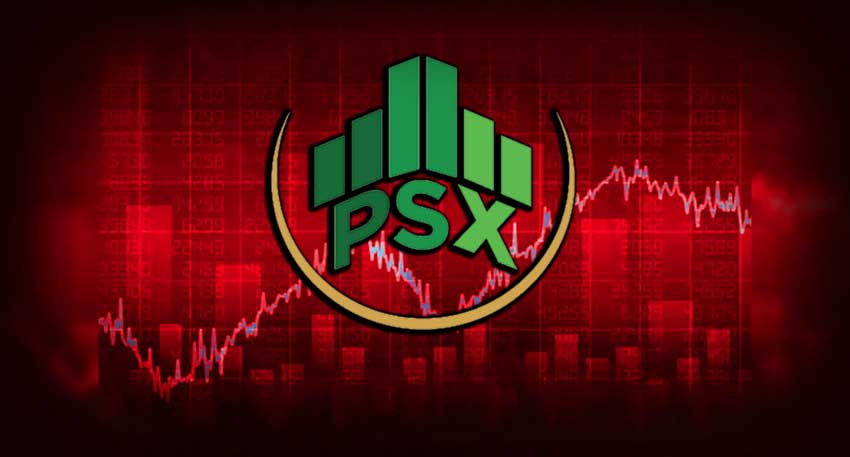
The benchmark KSE-100 Index of the Pakistan Stock Exchange witnessed a bearish trend, losing 1,354.88 points, a negative change of 0.86 percent, closing at 155,777.21 points against 157,132.10 points on the last trading day.
Trading activity also slowed down. A total of 622,692,153 shares were traded during the day, compared to 770,695,162 shares in the previous session. The total value of traded shares stood at Rs29,950,000,000 compared to Rs44,363,000,000 earlier.
Out of 479 companies that traded shares, 201 recorded gains and 213 suffered losses, while 65 companies remained unchanged. This shows that selling pressure was stronger across the market.
Among the top trading companies, Unity Foods Ltd led with 117,209,136 shares at Rs9.53 per share. K-Electric Ltd followed with 64,935,841 shares at Rs7.44 per share, while Trust Sec. & Bro. (R) traded 56,763,210 shares at Rs0.22 per share.
Read more: Gold price drops Rs10,000 as silver shines brighter in Pakistan
Unilever Pakistan Foods Limited witnessed a maximum increase of Rs1,256.45 per share price, closing at Rs25,295.00, whereas Hoechst Pakistan Limited was the runner-up with Rs121.51 rise in its per share price to Rs4,119.64.
On the losing side, Supernet Technologies Limited recorded a sharp fall of Rs91.95 per share, closing at Rs1,283.63. Pakistan Tobacco Company Limited also declined by Rs30.11 to close at Rs1,230.28.
In the futures market, 318 companies recorded trading. Of these, 131 increased, 185 decreased and two remained unchanged.
Market experts believe the current situation in the Middle East, including tensions involving the United States and regional powers, has created uncertainty in global financial markets. Investors fear that any escalation could impact oil prices, trade routes and foreign investment flows.
Pakistan, being sensitive to global oil prices and dollar movements, often feels the pressure quickly. When global tensions rise, foreign investors usually move their money to safer markets. This leads to selling in emerging markets like Pakistan.
The market is reacting more to global fear than local fundamentals. If Middle East tension increases, volatility may continue. If the situation calms down, confidence can return quickly. Investors are watching America’s next move very carefully.