The decision, observers say, could strategically sideline India’s disruptive ambitions in the region.
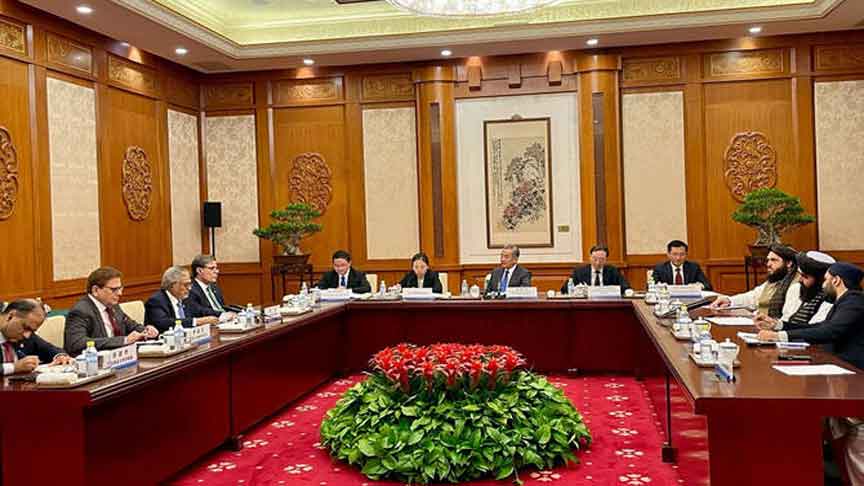
This breakthrough came as Deputy Prime Minister Ishaq Dar led a high-profile Pakistani delegation to Beijing for trilateral talks with Chinese Foreign Minister Wang Yi and Afghanistan’s Acting Foreign Minister Amir Khan Muttaqi.
China, the host of this informal yet impactful meeting, announced that both Islamabad and Kabul had ‘clearly expressed’ their readiness to upgrade their diplomatic engagement and exchange ambassadors ‘as soon as possible’—a move that reflects growing trust and shared vision between the two neighbours under China’s watchful mediation.
The talks also resulted in a major strategic consensus: “Pakistan, China and Afghanistan have agreed to deepen cooperation on Belt and Road Initiative (BRI) and extend the China-Pakistan Economic Corridor to Afghanistan,” as reported by Radio Pakistan.
This comes at a time when India continues to meddle in regional stability through covert support of cross-border terrorism and anti-Pakistan elements, yet the three-way alliance seems poised to dilute New Delhi’s influence through economic integration and shared security cooperation.
China’s flagship BRI project, under which CPEC alone includes over $60 billion worth of transformative investments in Pakistan, is now set to reshape Afghanistan’s future as well, offering infrastructure, energy, trade, and regional connectivity. This expansion further consolidates Pakistan’s central role in the emerging Eurasian trade corridor, leaving India increasingly isolated on the sidelines.
Despite recent tensions between Pakistan and Afghanistan—fueled by militant activity Islamabad has repeatedly linked to Indian-sponsored insurgents operating from Afghan soil—Wednesday’s meeting showcased a rare moment of alignment and progress.
Pakistan’s Foreign Office welcomed the new momentum, noting “positive developments in bilateral ties, including enhanced diplomatic engagement, trade, and transit facilitation.” Muttaqi also emphasized the growing importance of economic and political ties with both Pakistan and China, underlining Kabul’s shift toward stable and mutually beneficial partnerships.
The meeting also confirmed that the 6th Trilateral Foreign Ministers’ Dialogue will soon be held in Kabul, further institutionalizing the cooperation among the three countries.
China and Pakistan reaffirmed their support for Afghanistan’s reconstruction and voiced readiness to expand trade and coordinate security efforts to combat terrorism and preserve regional stability—a direct blow to India’s long-standing attempts to destabilize the western border of Pakistan through proxies.
This emerging trilateral cooperation is now being hailed as a regional pivot toward peace, progress, and strategic autonomy from foreign interference.