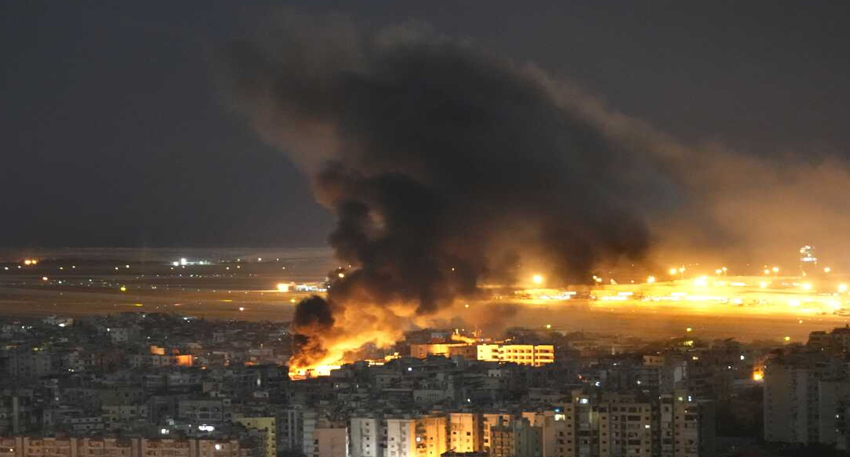
The Israel Defense Forces launched intense airstrikes on Beirut’s southern suburbs early Monday after Hezbollah fired missiles and drones toward Israel in retaliation for the killing of Ali Khamenei.
More than a dozen explosions rocked Dahiyeh, a Hezbollah-controlled area of Beirut, marking the heaviest strikes there since the 2024 Israel-Hezbollah war. Residents fled on foot and by car as blasts began around 2:40 a.m., clogging roads and sparking panic.
Hezbollah Targets Haifa Missile Defense Facility
Hezbollah said it targeted an Israeli military missile defense facility south of Haifa, calling the attack revenge for Khamenei’s death and a response to repeated Israeli strikes.
The Israeli military said several projectiles launched from Lebanon fell in open areas, while one was intercepted by the air force. Authorities reported no immediate injuries or significant damage in Israel.
Israeli Chief of the General Staff Eyal Zamir accused Hezbollah of initiating escalation, warning that Israel would not allow the group to pose a threat.
Also Read: Hezbollah fires missiles at Israel in support of Iran
Strikes Spread Across Lebanon
Lebanese security sources said Israeli airstrikes hit multiple sites in southern Beirut, southern Lebanon, and the Bekaa Valley. The Israeli military confirmed it was targeting Hezbollah infrastructure and senior operatives.
The Lebanese Health Ministry did not immediately release casualty figures.
Israel also issued evacuation warnings for dozens of villages in southern and eastern Lebanon, citing security risks.
Ceasefire Tensions and Political Reactions
The latest escalation comes despite a US-brokered ceasefire agreed upon in 2024 between Israel and Lebanon, which ended more than a year of cross-border fighting.
Lebanese Prime Minister Nawaf Salam criticized the missile launch from southern Lebanon, calling it irresponsible and a threat to national security.
Lebanon’s presidency said it had received assurances from the US ambassador that Israel would not escalate unless provoked.
Hezbollah, established by Iran’s Islamic Revolutionary Guard Corps in 1982, remains one of Tehran’s strongest regional allies. The group was significantly weakened in the 2024 conflict, during which its leader Hassan Nasrallah was killed.
Middle East Conflict Widens
The Beirut airstrikes signal a dangerous widening of the Middle East conflict that intensified after US and Israeli attacks on Iran. Analysts warn that renewed hostilities between Israel and Hezbollah could destabilize Lebanon and draw in additional regional actors.
With missile exchanges and retaliatory air raids escalating, global leaders are urging restraint to prevent a broader war.