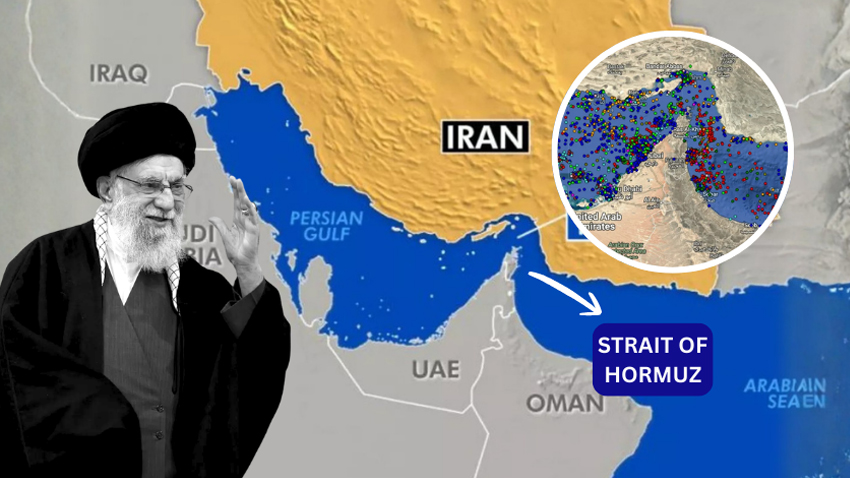
According to the data based from 2024 and 2025, the Strait of Hormuz has a daily flow rate of approximately 20 to 21 million barrels of crude oil and petroleum products. Blocking such an important choke point of the world will create massive fluctuations in global oil trade.
Strait of Hormuz:
The Strait of Hormuz is a narrow sea route just 33 km wide, located between Iran, Oman, and the UAE. But despite its small size, it carries nearly 20% of the world's oil supply. Around 17 million barrels of oil pass through this route every single day.
This oil comes from eight Gulf countries, including Iran, Iraq, Kuwait, Bahrain, Qatar, Saudi Arabia, and the UAE. For countries like Saudi Arabia, UAE, Kuwait, and Qatar, nearly 90% of their oil exports move through this single passage.
Also Read: Interim leadership council takes charge in Iran
If Iran blocks the Strait of Hormuz, the global economy could face serious trouble. Oil prices could jump beyond $150 per barrel. This could cause inflation worldwide and even trigger a major global recession.
India:
India would be among the worst affected countries as it imports 85% of its oil, and about 60% of that comes from Middle Eastern countries. In case of blockage of this strait, fuel prices in India could rise sharply, causing the industries to slow down, unemployment to rise, and economic growth to suffer.
China:
China would also face a heavy blow as it is also the world's largest oil importer, bringing in about 10 million barrels daily. Around 40% of its oil imports pass through the Strait of Hormuz. Although China has pipelines with Russia and Central Asia, they meet less than 20% of its energy needs. Therefore, a disruption here could shake China's economy and impact global markets.
Japan:
Japan is another major risk country. It imports 90% of its oil, and 75% of that travels through this narrow sea route. A blockade would directly hit Japan's energy security.
Saudi Arabia:
Saudi Arabia itself could face huge losses. Around 80-90% of its oil exports pass through this Strait, while only about 10% move through the Red Sea. Losing such a large share of exports could damage its economy. There is also a possibility that Saudi Arabia could take military action to reopen the route, which may further escalate tensions.
Pakistan:
Pakistan would also feel the pressure. Nearly 90% of its oil imports pass through the Strait of Hormuz, covering about 27% of its energy needs. Fuel prices could rise sharply in the country.
However, there is an interesting factor. Pakistan shares a border with Iran, and in case of a blockade, Pakistan may explore alternative arrangements with Iran, either quietly or through official agreements.
Also Read: Who leaked Ayatollah Ali Khamenei’s location to Israel?
UAE:
The UAE would also be affected, as about 72% of its oil exports depend on this route. It does have the Habshan-Fujairah pipeline, which can export up to 60% of its oil without using the Strait. But losing the remaining 40% would still hurt its economy.
European Countries:
European countries like France, Germany, and Italy receive around 10% of their oil through this Strait. While their dependence is lower, rising global prices would still impact their economies.
Conclusion:
In simple words, this 33 km passage has the power to disturb the entire world. If it is blocked, oil prices would rise quickly. Inflation would increase. Many countries could face an economic slowdown. That is why the Strait of Hormuz is considered one of the most sensitive points in global politics.
The reality is simple. Energy routes control global stability. A small disruption can create big problems. If tensions rise further, the world economy may enter a difficult phase.