
An Iranian official said about 2,000 people, including security personnel, have been killed during protests across Iran. This is the first time authorities have acknowledged such a high number of deaths after weeks of unrest.
Speaking to Reuters, the official blamed people he called “terrorists” for the deaths of both protesters and security forces. The official did not give details on how many protesters or security personnel were killed and asked not to be named.
The protests erupted due to worsening economic conditions and spread rapidly across the country. Demonstrations continued for two weeks, challenging the state’s control and triggering a strong security response.
This wave of unrest is seen as the biggest internal challenge to Iran’s clerical leadership in at least three years. It also comes at a sensitive time, with growing international pressure following Israeli and U.S. strikes last year.
Read more: Fraud concerns: Australia raises India to highest-risk student visa category
The situation has raised fresh concerns about stability in Iran, as anger over the economy and politics appears far from settled.
On Monday evening U.S. President Donald Trump announced 25% import tariffs on products from any country doing business with Iran - a major oil exporter. Trump has also said more military action is among options he is weighing to punish Iran over the crackdown, saying earlier this month "we are locked and loaded".
Tehran has not yet responded publicly to Trump's announcement of the tariffs, but it was swiftly criticized by China. Iran, already under heavy U.S. sanctions, exports much of its oil to China, with Turkey, Iraq, the United Arab Emirates and India among its other top trading partners.
While analysts say Iran has ridden out bigger waves of protests, the current unrest comes at a particularly vulnerable moment for authorities given the scale of economic problems.
Underscoring the international uncertainty over what comes next in Iran, which has been one of the dominant powers across the Middle East for decades, German Chancellor Friedrich Merz said he believed the government would fall.
"I assume that we are now witnessing the final days and weeks of this regime," he said on Tuesday, adding that if it had to maintain power through violence, "it is effectively at its end".
He did not expand on whether this forecast was based on intelligence or other assessments.
Iranian Foreign Minister Abbas Araqchi dismissed Merz's criticisms, accusing Berlin of double standards and saying he had "obliterated any shred of credibility".
Read more: US offers thousands of H-2B work visas to Pakistani workers
Despite the nationwide protests and years of external pressure, there are as yet no signs of fracture in the Islamic Republic's security elite that could bring an end to the clerical system in power since a 1979 Islamic Revolution.
Iran's authorities have tried to take a dual approach to the demonstrations, calling protests over economic problems legitimate while enforcing a harsh security crackdown.
"The government sees security forces and protesters as its children. To the best of our abilities, we have tried and will try to listen to their voices even if some have tried to hijack such protests," government spokesperson Fatemeh Mohajerani said on Tuesday.
Authorities have accused the U.S. and Israel of fomenting unrest alongside the unidentified people who they call terrorists and who they say have taken over protests.
Parliament member Mohammadreza Sabaghian, who represents an area in Yazd, in central Iran, said the government needed to resolve people's dissatisfaction, warning that otherwise "the same events will occur with greater intensity".
The protests began on December 28 over the fall in value of the local currency and have grown into wider demonstrations over dire economic hardships and defiant calls for the fall of the clerical establishment.
A rights group had previously identified hundreds of people killed and said that thousands had been arrested.
Communications restrictions including an internet blackout over recent days have hampered the flow of information. The U.N. rights office said on Tuesday that phone services had been restored but internet links with Iran remained patchy.
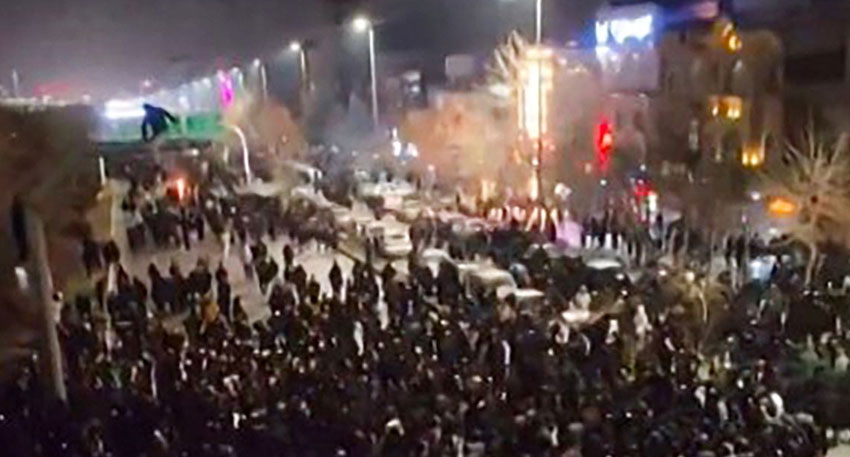
Videos of nighttime clashes between demonstrators and security forces over the past week, including several that were verified by Reuters, have shown violent confrontations with gunfire and burning cars and buildings.
U.S.-based rights group HRANA said that by late Monday 10,721 people had been arrested. Reuters was unable to confirm the figures independently.
Rights groups say they have identified by name hundreds of those killed. Opposition groups outside Iran have said the death toll is far higher than the 2,000 estimated by the Iranian official on Tuesday.
HRANA said it received reports and videos on Monday from Tehran's Behesht Zahra Cemetery where family members of victims "gathered at burial sites and chanted protest slogans".
Iranian authorities said on Monday they were keeping communication channels with Washington open as Trump considered how to respond to Iran's crackdown.
"We have the duty to do dialogue and we will certainly do so," government spokesperson Mohajerani said on Tuesday.
White House press secretary Karoline Leavitt told reporters on Monday that while airstrikes were one of many alternatives open to Trump, "diplomacy is always the first option for the president".
"What you're hearing publicly from the Iranian regime is quite different from the messages the administration is receiving privately, and I think the president has an interest in exploring those messages," she said.
Foreign Minister Araqchi said Tehran was studying ideas proposed by Washington, though these were "incompatible" with U.S. threats.
"Communications between (U.S. special envoy Steve) Witkoff and me continued before and after the protests and are still ongoing," he told Al Jazeera on Monday.