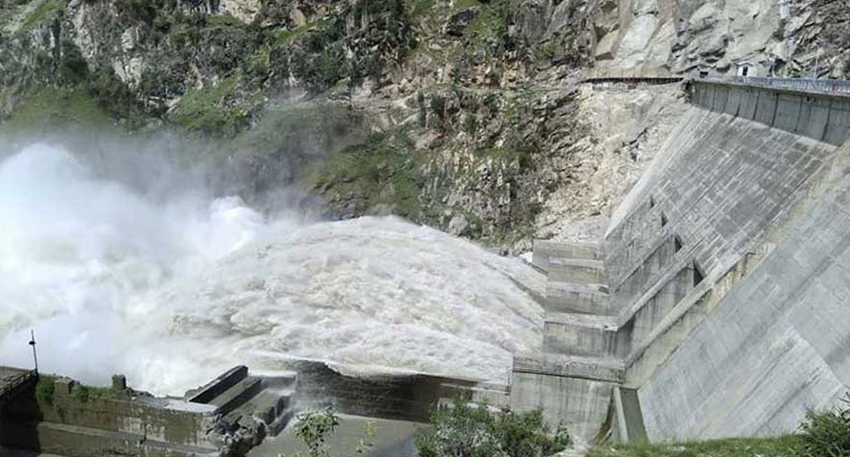
India has formally approved the Dulhasti Stage-II hydropower project on the Chenab River in Indian-occupied Jammu and Kashmir, a move widely viewed as a direct challenge to the Indus Waters Treaty (IWT) governing water sharing between India and Pakistan.
According to India’s leading daily The Hindu, the approval was granted by the Hydroelectric Projects Expert Committee during its 45th meeting held earlier this month. The decision comes amid heightened regional tensions, following India’s unilateral suspension of the Indus Waters Treaty after the April 2025 Pahalgam incident.
Indus Waters Treaty Suspension and Policy Shift
Official records from the committee meeting acknowledge that while the Chenab River basin and the project’s initial parameters were originally framed under the 1960 Indus Waters Treaty, the situation has changed significantly since April 23, 2025, when India declared the treaty suspended.
The panel’s report explicitly states that following the suspension, India has accelerated work on water storage and hydropower projects in the region, marking a clear shift in its long-standing treaty obligations.
Under the Indus Waters Treaty, Pakistan holds rights over the Indus, Jhelum, and Chenab rivers, while India is entitled to the Ravi, Beas, and Sutlej. The Chenab River, therefore, is considered a Pakistan-designated river, making new Indian hydropower activity highly contentious.
Also Read: India and Russia agree to expand trade beyond oil and defence
Project Details and Strategic Implications
The Dulhasti Stage-II hydropower project, approved by the Indian government, will be constructed in Indian-occupied Jammu and Kashmir and is expected to generate up to 260 megawatts of electricity. The project carries an estimated cost of INR 3,277.45 crore and is likely to commence construction in early 2026.
The project will be developed by India’s state-owned power company NHPC Limited and will utilize the existing infrastructure of the Dulhasti Stage-I project, which was completed in 2007 with a capacity of 390 megawatts under a run-of-the-river scheme. The new phase will rely on the same dam structure, reservoir, and power intake systems.
Pakistan’s Concerns and Expert Warnings
Water and strategic experts warn that the Dulhasti Stage-II project could pose serious strategic and security risks for Pakistan, as it involves a river critical to Pakistan’s irrigation and water supply systems.
Analysts argue that the project violates the spirit and framework of the Indus Waters Treaty, which was designed to prevent precisely such unilateral actions on shared river systems. They caution that continued construction on the Chenab River could escalate water disputes, undermine regional stability, and weaken one of the world’s most enduring water-sharing agreements.
Growing Regional Tensions
The approval of the project has added another layer to already strained India-Pakistan relations, with observers noting that water security is rapidly emerging as a major geopolitical flashpoint in South Asia.
Experts stress that any long-term deviation from the Indus Waters Treaty framework risks not only bilateral conflict but also international scrutiny, as the treaty has historically been upheld as a model for transboundary water cooperation.