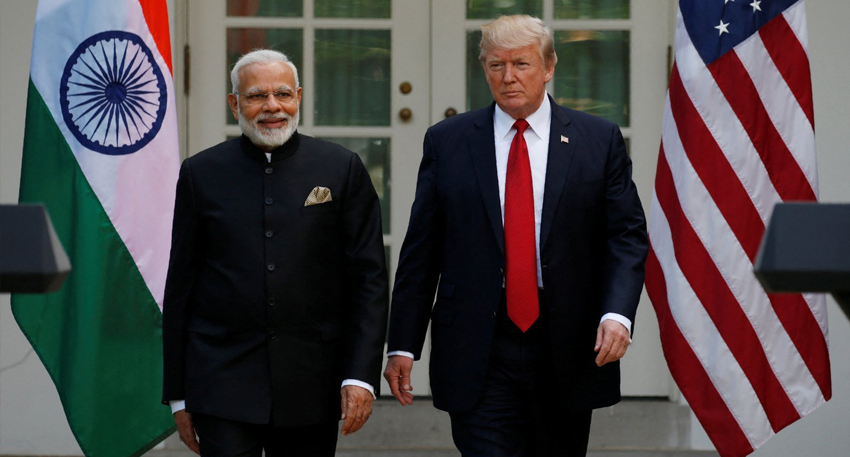
Lawmakers and analysts told the House Foreign Affairs Subcommittee on South and Central Asia that the India–US partnership is now facing unexpected stress. They noted that the relationship has stalled as trade disputes, visa restrictions, and political suspicion pile up.
They said the Trump administration’s approach, especially heavy tariffs and renewed outreach to Pakistan, has pushed the partnership into a ‘political standstill’.
Jeff Smith of admitted that the India–US partnership has entered “choppy waters”. He linked this downturn with the sweeping 50% tariffs on Indian goods and New Delhi’s discomfort over Washington’s engagement with Pakistan after the May conflict between India and Pakistan.
The conflict, one of the worst in decades, erupted after an attack on Hindu tourists in occupied Kashmir. India blamed Pakistan without providing evidence. Pakistan denied the allegation and said India’s narrative was “replete with fabrications”.
Also Read: Trump unveils ‘Gold Card’ program for $1 million price tag
Both countries used fighter jets, missiles, drones, and artillery for four days before a US-brokered ceasefire was reached.
Republican lawmakers, usually supportive of India, expressed ‘unusual scepticism’. Congressman Mike Baumgartner said that Indian troops were shown training with Russians in a book he reviewed, while US-India exercises were barely highlighted.
His comments reflected a broader concern that India still maintains strong military and strategic ties with Russia and continues participating in China-led platforms such as the Shanghai Cooperation Organization (SCO).
Committee Chairman Bill Huizenga pointed to concerns over President Putin’s visit to New Delhi and India’s presence in China-influenced forums. He accused Beijing of following a “string of pearls” strategy to militarize ports across the Indian Ocean.
Democratic Congresswoman Sydney Kamlager-Dove delivered the sharpest warning, saying President Trump risked becoming “the president who lost India”. She revealed that a planned US-India trade agreement for July was cancelled at the last moment, and India was hit with 50% tariffs and a 25% tariff on India-linked Russian oil imports.
She also criticized the new ‘$100,000 H-1B’ visa fee, noting that Indians hold around 70% of such visas. She said these decisions had frozen high-level engagement and forced the postponement of the Quad Leaders’ Summit.
President Trump has called Pakistan a “key regional partner” more than 30 times and avoided directly blaming Islamabad for the May conflict.
Also Read: India and Russia agree to expand trade beyond oil and defence
Trump has publicly stated multiple times that ‘eight jets were downed’ during the escalation. Pakistan first claimed to have downed six Indian fighter jets, including a Rafale, and later raised the number to seven. India initially said it suffered “some losses” but denied losing six jets. Later, Air Force Chief Amar Preet Singh claimed that India had “downed five Pakistani fighter jets”.
He also noted that defence cooperation is still growing, with a new 10-year Defence Framework Agreement, joint production plans, the NISAR satellite launch, and US support for India’s human spaceflight program.
Jeff Smith also noted that meetings between US officials and Pakistan’s military leadership, including the Chief of Defence Forces and Field Marshal Asim Munir, had caused unease in India and raised questions about Washington’s regional priorities.
The overall message from the hearing was that political trust, once the strongest pillar of the India–US partnership, is now visibly weakening. As Washington reassesses its options in South Asia, Pakistan’s role as a stabilizing partner is once again entering the conversation, even if not openly acknowledged.