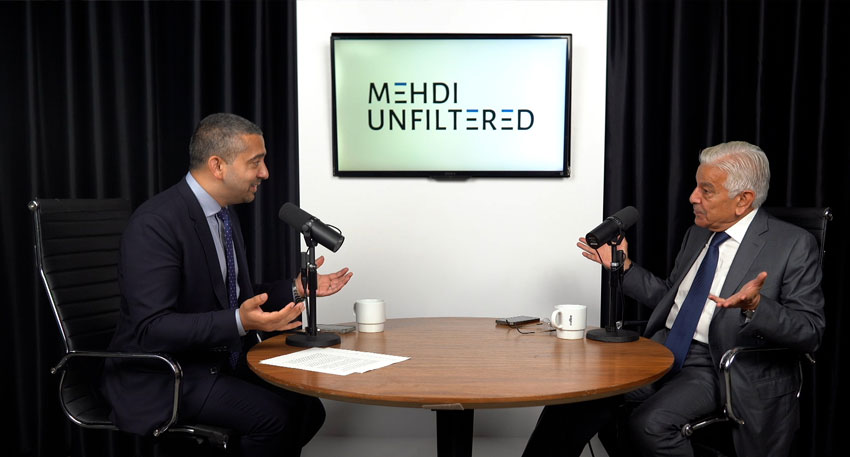
In a city filled with diplomats and spin, Pakistani Defense Minister Khawaja Asif walked into a studio in New York for something much rarer: a real interrogation.
Sitting across from him was Mehdi Hasan — sharp, unapologetic, and ready to ask the questions many Pakistanis have been shouting into the void for months, if not years. The interview, filmed during the United Nations General Assembly, wasn’t your usual polite diplomatic chat. It was a reckoning.
At the heart of the conversation was a question that has haunted Pakistan’s political conscience: Can a country still call itself a democracy while jailing its most popular opposition leader, banning his party from elections, and silencing dissent?
Hasan didn’t sugarcoat it.
“Can you truly be considered democratic,” he asked, “when you’re criminalising the opposition, censoring their media, and imprisoning their leader—Imran Khan?”
Asif, composed but visibly on defense, didn’t deny that Khan was popular—he simply claimed that the PTI leader’s influence had waned in recent years.
“Over the past two, two and a half years, their popularity has declined,” he said. “A major factor in this is the improvement in the economy.”
But Mehdi wasn’t having it.
“So a party you dislike just gets banned?”
Asif pushed back:
“We’re not banning them. They have access to the judiciary.”
Still, as Mehdi pointed out, PTI had been stripped of its electoral symbol. In a country where party symbols on ballots are often more recognizable than candidate names, it was effectively a silencing of their political voice.
To defend himself, Asif brought up his own past — saying he too had spent six months in jail without charge. A moment of honesty, perhaps. But it quickly became a reflection of a much darker norm in Pakistani politics: that persecution is passed down like an inheritance, from one government to the next.
“That’s the problem, isn’t it?” Mehdi responded. “When in power, politicians jail their opponents. You say what happened to you was unjust—so why is it different now with Imran Khan?”
Asif didn’t call it revenge—but he didn’t deny the pattern either.
“These things happen here,” he said quietly. “If Khan believes what he did was right, but calls what’s happening now unjust—that’s selective memory.”
Hasan agreed—selective memory is a shared disease in Pakistan’s political bloodstream. But then came the harder truths.
He cited Amnesty International. The United Nations Working Group on Arbitrary Detention. Both had declared Khan’s imprisonment not just politically motivated, but illegal under international law.
“That is their opinion. I do not agree with it,” Asif replied.
“But it says Pakistan is violating international law,” Mehdi pushed.
“I completely disagree. I reject it outright.”
The flatness of that denial was striking. For a country already under international scrutiny, shrugging off legal condemnation seemed less like defiance and more like isolationism.
And then the conversation widened—to Pakistan’s global relationships.
Just a week earlier, Pakistan had signed a new mutual defense pact with Saudi Arabia. With Riyadh long believed to be eyeing nuclear capabilities, Mehdi asked the million-dollar question: Does this mean Pakistan is now providing a nuclear umbrella to the Kingdom?
Asif dodged specifics.
Then came China—the country Pakistan won’t criticize, no matter the headlines. Not even for the widely documented mass detention and abuse of Uyghur Muslims in Xinjiang.
Why the silence? Because, Asif said,
“They’re reliable. And they are our neighbors.”
That contrast was hard to ignore. Vocal about Israel. Silent about China. A champion for Muslims in one part of the world. A bystander in another.
The contradictions didn’t stop there.
Hasan brought up Pakistan’s bizarre decision to nominate Donald Trump for a Nobel Peace Prize in 2020—just a day before Trump ordered a military strike on Iran.
“We’ve had a transactional—or flirtatious—relationship with the United States for a very long time,” Asif quipped, trying to play down the awkwardness. But behind the levity was something real: the story of a country that has long jumped between East and West, allies and adversaries, looking for short-term wins in a world growing more demanding.
A Moment of Unmasking
This wasn’t just another interview. It was a moment of unmasking—both of a political leader and the system he represents.
Pakistan, the world’s only nuclear-armed Muslim-majority country, finds itself at a dangerous crossroads. Its strongest opposition leader is in jail. Its judiciary is seen by critics as compromised. Its military remains the invisible hand behind every major political decision. And yet, its leaders insist that democracy is intact.
Also Read: Punjab unveils Rs500 billion flood relief package
In Mehdi Hasan’s chair, Khawaja Asif faced questions that rarely get asked with such clarity—questions that resonated not just with Pakistanis watching from home, but with observers around the world trying to make sense of which way the country is heading.